




Key Takeaways
- Ripple’s XRP has recorded six straight monthly declines — a streak unseen since 2014 — plunging over 60% from its peak of $3.65.
- Price action remains trapped between $1.33 and $1.38, with sellers consistently rejecting attempts to push higher.
- ETF products tied to Ripple attracted $3.32 million in fresh capital, reversing March’s outflow trend, though momentum remains fragile.
- Large-holder wallets have been accumulating more than 11 million XRP daily over a 30-day period, based on April 6 CryptoQuant metrics.
- A monthly close above $1.33 would officially end the downtrend, with regulatory clarity and Bitcoin’s strength cited as potential turning points.
Ripple’s XRP token has endured a half-year of consecutive monthly declines, marking its most prolonged slump in over a decade. Trading more than 60% below its cycle peak of $3.65 set last July, the digital asset has struggled to sustain any meaningful recovery despite occasional bounces toward $1.40.
The downward spiral began in October 2025 when former President Trump’s announcement of sweeping 100% tariffs on Chinese imports sparked unprecedented turmoil across cryptocurrency markets. In a single 24-hour window, more than $19 billion in leveraged positions evaporated. XRP tumbled from above $2.80 to sub-$2.00 levels within days.
Attempts to regain ground during November and December faltered amid persistent ETF outflows and waning institutional appetite. By late February 2026, geopolitical tensions intensified as Iran-related conflicts caused oil to spike past $100 per barrel following the closure of the Strait of Hormuz.
The Federal Reserve’s subsequent upward revision to inflation projections prompted institutions to retreat from higher-risk assets. Despite positive developments for XRP in 2026 — including commodity classification discussions, ETF interest, and strategic Ripple partnerships — macro headwinds proved insurmountable.
Pressure from existing holders compounded the sell-side weight. Roughly 60% of circulating XRP remains underwater. Each rally toward the $1.44 average acquisition price triggered waves of exit liquidity as loss-averse investors sought breakeven exits. This cyclical selling pattern persisted throughout the November-to-March period.
Resistance Zone Continues to Cap Recovery Efforts
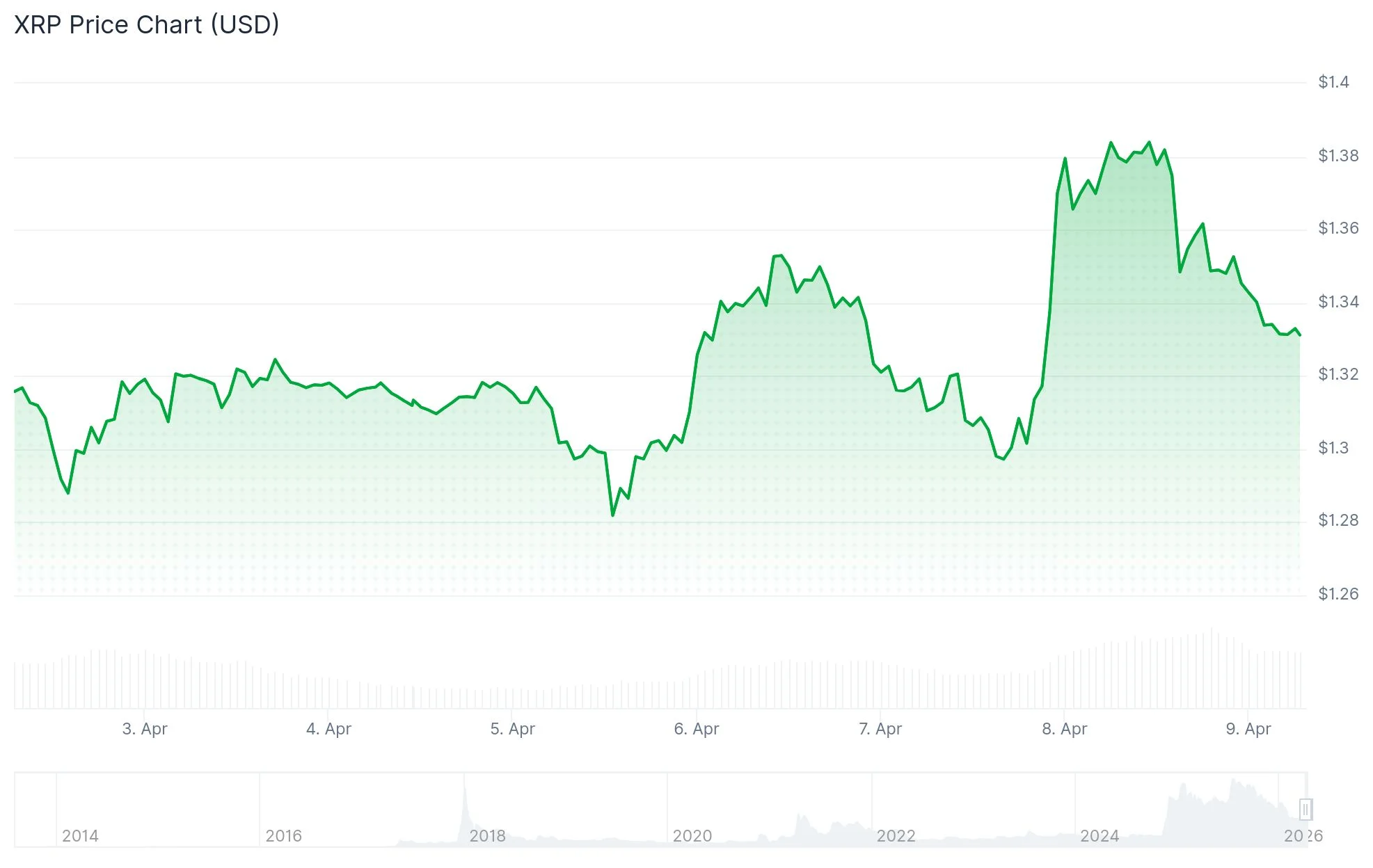
Intraday charting reveals XRP sliding from $1.37 to $1.33, with accelerated selling following a rejection at the $1.38 threshold. Elevated trading volume accompanied the decline, signaling active distribution. A brief dip to $1.31 materialized before a shallow stabilization, though rebound attempts have lacked conviction.
A descending resistance line has emerged with the ceiling positioned at $1.3550. Current trading activity sits beneath the 100-hour Simple Moving Average. The combination of rising volume and falling price typically indicates ongoing distribution rather than strategic accumulation.
Investment products linked to Ripple posted $3.32 million in net inflows, breaking a pattern of withdrawals seen throughout March. Yet thinning liquidity on major exchanges elevates the risk of volatile price swings should critical support zones fail. Immediate price floor stands at $1.33, with $1.28 representing the next crucial defensive line.
Large Holders Reach Decade-High Buying Pace
According to CryptoQuant intelligence dated April 6, whale-tier accumulation has reached levels not witnessed in ten months. High-net-worth wallets have absorbed upward of 11 million XRP tokens daily when measured across a rolling 30-day window. Simultaneous acceleration in exchange withdrawals has tightened available sell-side supply.
XRP dominated cryptocurrency ETF inflows during the previous week, capturing $120 million in fresh institutional capital. Bitcoin has rallied above the $71,000 threshold while XRP maintains positioning above $1.35.
XRP concluded March trading at $1.33. Any monthly settlement above this benchmark would officially terminate the six-month losing sequence. The CLARITY Act — legislation that would formally designate XRP as a digital commodity under federal regulation — may advance if the Senate Banking Committee concludes its review process before the end of April.
