




TLDR
- Global energy markets faced disruption after U.S.-Israeli strikes associated with “Operation Epic Fury” sent crude oil soaring beyond $116 per barrel
- More than $2 trillion vanished from U.S. stock futures during Monday’s opening hours
- The cryptocurrency sector shed $40 billion in market value across the weekend, with Bitcoin dropping under $66,000 and Ethereum falling to $1,960
- Key inflation metrics arrive this week: CPI data on Wednesday and the PCE index on Friday
- Markets assign a 95.5% chance that the Federal Reserve will hold rates steady at its March 18 policy meeting
Global energy markets experienced severe turbulence Monday as crude oil prices climbed to $116 per barrel following military operations connected to “Operation Epic Fury.” The escalating U.S.-Israeli confrontation with Iran sparked concerns about potential supply chain interruptions affecting shipments through the Strait of Hormuz.
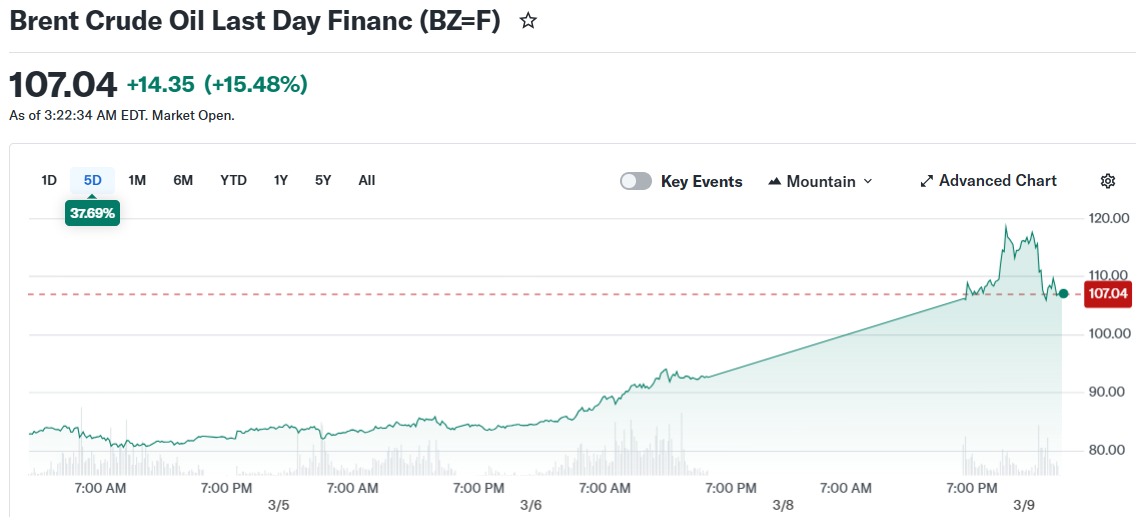
West Texas Intermediate experienced an intraday surge of up to 22% during Monday’s early session. Brent crude followed a similar trajectory, with market experts cautioning that constrained tanker movement through the Strait of Hormuz — a critical chokepoint handling roughly 20% of worldwide petroleum transport — could sustain elevated pricing levels.
On March 8, President Donald Trump took to Truth Social to address the price increase, stating: “Short term oil prices, which will drop rapidly when the destruction of the Iran nuclear threat is over, is a very small price to pay for U.S.A., and world, safety and peace.”
The nationwide average for gasoline in the United States stood at approximately $3.45 per gallon before accelerating upward as energy market instability intensified.
Experts from Rystad Energy cautioned that even with a resolution to the Iranian nuclear situation, petroleum prices might remain in the $100–$110 range for a prolonged duration due to persistent maritime risks across the Persian Gulf region.
Equities and Digital Assets Take Major Hits
U.S. equity futures witnessed more than $2 trillion in valuation losses during Monday’s morning session. The Kobeissi Letter characterized the event as “one of those days that will be referenced for decades to come,” highlighting that 20 million barrels daily of petroleum supply went offline with no indication of tension reduction.
Digital currency markets experienced a $40 billion decline throughout the weekend, reducing aggregate market capitalization to $2.36 trillion. Bitcoin encountered selling pressure at the $68,000 level on Sunday and declined beneath $66,000 before experiencing modest gains during Monday’s Asian trading session.
Ethereum struggled to maintain support above $2,000 through the weekend and traded at $1,960 as of this writing. The majority of alternative cryptocurrencies showed minimal movement across the preceding 24-hour period.
Risk-sensitive assets such as digital currencies typically respond swiftly to geopolitical developments, and recent events proved no exception.
Critical Inflation Metrics Loom Over Markets
The February Consumer Price Index report arrives Wednesday. With energy costs climbing, market watchers anticipate inflation figures will reflect increased price pressures.
The Federal Reserve’s preferred inflation indicator, the Personal Consumption Expenditures index covering January, releases Friday. Projections suggest a 0.4% monthly gain, mirroring December’s advance and representing consecutive elevated readings.
The Federal Reserve convenes for its policy meeting March 18. CME Group futures data indicates a 95.5% probability that policymakers will maintain current interest rate levels at that gathering.
Internal deliberations at the Fed have acknowledged that persistently elevated energy expenses could present challenges for monetary policy strategy moving forward.
