



Key Takeaways
- JPMorgan’s global market intelligence leader adopted a “tactically bearish” stance on American equities this week
- The S&P 500 would drop to approximately 6,270 if it corrects 10% from its recent high
- Crude oil prices have surged past the $100 threshold amid escalating Middle East hostilities and attacks on energy facilities
- Morgan Stanley maintains its optimistic outlook, suggesting the market is completing a “rolling correction” phase begun last fall
- JPMorgan’s commodity analysts believe the current surge in petroleum product pricing is only beginning
JPMorgan Chase has issued a cautionary forecast suggesting the S&P 500 may experience a 10% decline from peak levels as Middle East hostilities drive crude oil beyond $100 per barrel.
Andrew Tyler, who leads JPMorgan’s global market intelligence division, adopted a “tactically bearish” posture toward American equities this week. The escalating Middle East situation represents his primary concern.
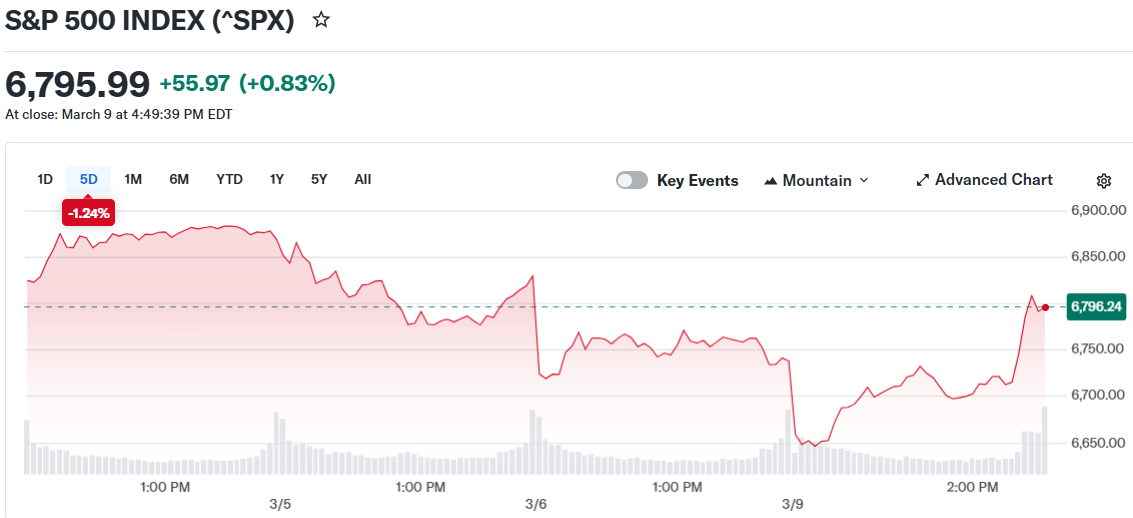
Should the index fall 10% from its peak, the S&P 500 would land near 6,270 points. This represents roughly a 7% decline from Friday’s closing level.
JPMorgan’s commodities analysts noted that energy infrastructure on both sides of the conflict has sustained damage. This represents an unprecedented development, and the team cautioned that the recent petroleum product price increases are only beginning.
“The precedent of oil infrastructure under attack has officially begun,” the desk wrote.
Oil breaking through the $100 threshold represents a critical juncture for economic stability. Elevated energy expenses translate to increased costs throughout multiple industries, potentially dampening corporate profitability.
Morgan Stanley’s Contrasting Perspective
Not all major Wall Street institutions agree with JPMorgan’s assessment. Morgan Stanley’s chief investment officer Mike Wilson maintains the firm’s constructive stance on equities for the upcoming six to twelve-month period.
Wilson characterizes the market as experiencing a “rolling correction” since last October, with performance remaining essentially flat despite robust earnings reports. His view suggests this corrective phase is approaching completion.
The divergent perspectives from these two banking giants highlight different interpretations of identical market conditions. JPMorgan identifies immediate downside vulnerabilities, while Morgan Stanley anticipates the market will soon stabilize.
Understanding a 10% Market Correction
A 10% reduction in the S&P 500 qualifies as a typical market correction. Such events occur with regular frequency and were witnessed in 2018, 2020, and 2022, with markets subsequently rebounding.
For pension plans and index-tracking mutual funds, such a decline would temporarily reduce portfolio valuations. Investment professionals typically advise maintaining positions and resisting impulse-driven liquidations.
JPMorgan’s cautionary stance specifically relates to escalating Middle East tensions and attacks on energy infrastructure. The institution hasn’t identified any particular domestic economic catalyst.
Crude prices exceeding $100 create challenges for consumer expenditures and business operating costs. Energy sector firms stand to gain from elevated pricing, while industries including aviation and manufacturing may encounter difficulties.
The S&P 500 comprises 500 of America’s largest publicly traded corporations. It ranks among the planet’s most extensively monitored market benchmarks.
JPMorgan manages $4.8 trillion in assets and stands as one of the world’s premier financial institutions. Its market perspectives receive considerable attention from both institutional and individual investors.
As of this week, the bank transitioned its U.S. equity stance from neutral to tactically bearish, motivated by deteriorating Middle Eastern conditions.
