




Contents
Key Takeaways
- The Pudgy Penguins brand successfully launched toys across 3,100 Walmart locations plus Target, achieving mainstream retail distribution unprecedented for most cryptocurrency ventures.
- The parent entity, Igloo, secured $11 million in venture funding during 2024, with Founders Fund spearheading the investment round.
- PENGU’s official documentation explicitly states the token exists solely “for fun and entertainment only” and possesses “no commercial value.”
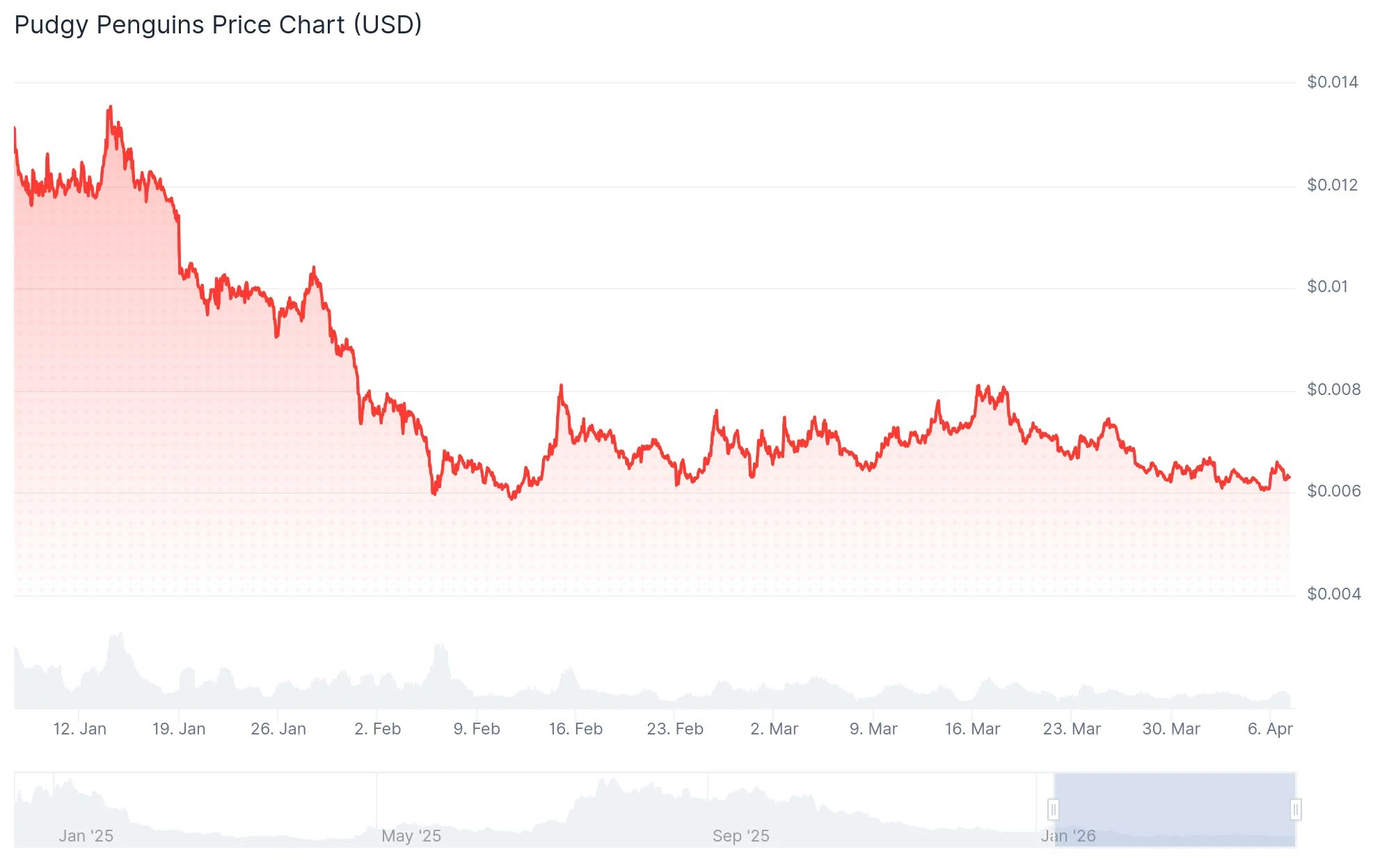
- With 88.89 billion tokens as maximum supply, PENGU maintains approximately $396 million in market capitalization, while fully diluted valuation approaches $503 million.
- Combined insider and corporate token reserves account for 29.28% of total supply, featuring vesting schedules extending into 2028.
What began as a non-fungible token collection has evolved into Pudgy Penguins, among the most identifiable crypto-originated brands today. Igloo, the operational entity steering the project, successfully transitioned the digital brand into tangible retail products now available at Walmart and Target stores nationwide. Such physical marketplace penetration remains exceptionally uncommon within cryptocurrency ecosystems.
The physical retail breakthrough stands as perhaps the brand’s most substantial accomplishment to date. Distribution of Pudgy Toys across 3,100 Walmart storefronts demonstrates a degree of consumer-facing exposure that remains virtually unmatched among blockchain-originated initiatives.
Furthermore, Igloo successfully completed an $11 million capital raise throughout 2024, with Founders Fund serving as lead investor. This caliber of traditional venture capital involvement establishes legitimacy extending well beyond typical cryptocurrency investment patterns.
Understanding PENGU Token Fundamentals
The PENGU cryptocurrency represents a distinctly separate consideration from the brand’s commercial operations. Based on official claim documentation, PENGU exists exclusively “for fun and entertainment only” while maintaining “no commercial value.” This specific terminology carries significant implications.
Essentially, individuals holding PENGU tokens possess no formal entitlement to revenues generated through toy merchandising, intellectual property licensing arrangements, or any other income streams the company produces. The token functions primarily as a cultural and community engagement mechanism rather than a financial instrument.
Despite this positioning, PENGU maintains active trading across exchanges with measurable liquidity. According to CoinGecko metrics, the maximum token supply reaches 88.89 billion units, with approximately 62.86 billion presently in circulation. Current market capitalization hovers around $396 million, while the fully diluted valuation approximates $503 million.
Token Distribution and Concentration Analysis
The allocation framework governing PENGU’s supply distribution merits careful examination. Information sourced from Tokenomist indicates 17.80% of total supply has been designated for present and prospective team members, with an additional 11.48% reserved for corporate purposes. These combined allocations represent 29.28% of aggregate supply controlled by company insiders and the corporate entity.
Vesting timelines extend through 2028, indicating the cryptocurrency market will experience continued dilution as these allocations progressively unlock throughout the coming years.
Considering a token structure explicitly disconnected from corporate revenue generation, this magnitude of concentrated insider holdings presents material considerations for prospective investors evaluating the asset.
Meanwhile, the underlying brand architecture supporting PENGU demonstrates continued expansion, evidenced by product placement within America’s two dominant retail chains alongside institutional capital secured throughout 2024.
Final Analysis
Pudgy Penguins represents a rare cryptocurrency-originated brand achieving meaningful physical retail market penetration. The distribution partnership with Walmart and Target is substantive, while Founders Fund participation provides traditional financial sector validation. However, the PENGU token presents a fundamentally different proposition—lacking formal revenue participation rights, carrying substantial insider allocation concentration, and featuring official documentation explicitly characterizing it as entertainment-focused. Brand momentum may continue accelerating, yet this commercial success contains no structural mechanism guaranteeing value transfer to token holders.
