



Key Takeaways
- Dollar index (DXY) surged to 99.34, marking the strongest performance since January 2026.
- Greenback appreciated approximately 1% versus both euro and yen amid ongoing Iran tensions.
- America’s energy self-sufficiency shields the dollar from petroleum price volatility.
- European currency faces headwinds as natural gas costs spike, with EUR/USD dropping roughly 1%.
- ING forecasts DXY may reach 99.50–100.00 range as long as energy costs remain high.
The greenback has surged to levels not witnessed since January 2026 as Middle Eastern tensions intensified, driving market participants toward the U.S. currency as their primary defensive investment.
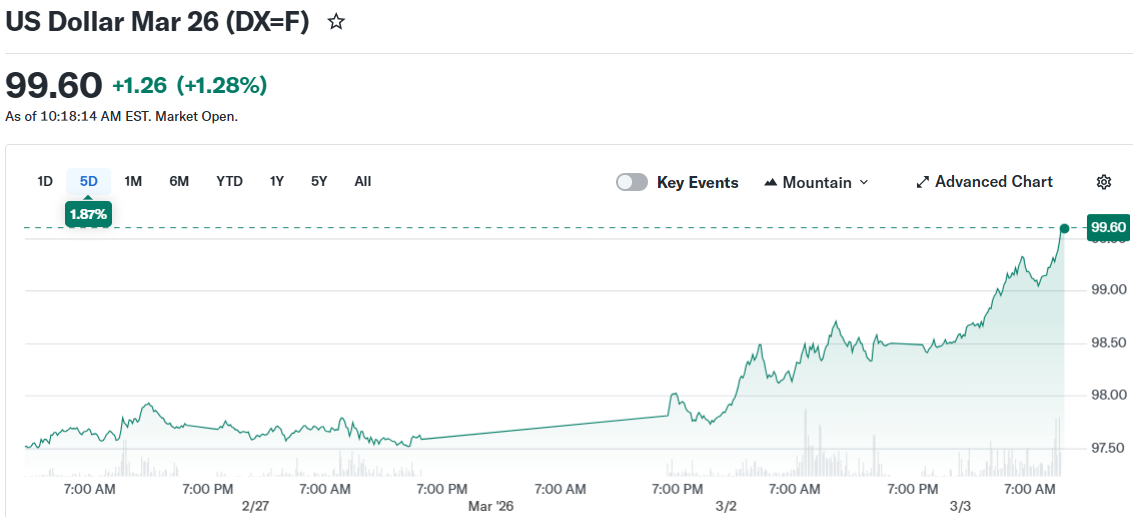
The dollar index (DXY), which tracks the American currency against six primary global currencies, advanced approximately 1% during Tuesday’s trading session to reach 99.34. This movement follows Monday’s nearly 1% appreciation.
The U.S. currency has strengthened by roughly 1% against both the euro and Japanese yen since tensions involving Iran began escalating. These currencies had previously been considered by certain market participants as viable alternatives to dollar holdings in recent months.
The conflict originated primarily as a U.S.-Iran confrontation but has subsequently expanded to involve surrounding nations. Media outlets reported missile attacks targeting the American embassy in Riyadh. Amazon cloud infrastructure facilities located in both the UAE and Bahrain were allegedly hit during Iranian counter-offensive operations.
On Tuesday, the U.S. State Department mandated evacuation of non-essential government staff and their families from Bahrain, Iraq, and Jordan. Israeli officials announced simultaneous military operations against both Iran and Lebanon, following Hezbollah’s missile and drone assault on Tel Aviv.
Factors Driving Dollar Strength
Market strategists highlight America’s energy self-sufficiency as a primary factor behind the currency’s outperformance. With substantial domestic energy resources, the United States faces less vulnerability to petroleum price increases compared to European and Asian economies.
“The dollar looks the best currency to take advantage of this energy shock,” ING analyst Chris Turner wrote. Countries like Australia and Norway, which are also large energy exporters, have also seen their currencies hold up.
This surge follows an extended period of uncertainty regarding the dollar’s defensive characteristics. The currency underperformed during previous year’s tariff-induced market turbulence, prompting speculation about accelerating de-dollarization trends.
David Morrison, senior market analyst at Trade Nation, said the move was “a strong indication that the U.S. dollar remains the go-to safe-haven currency” and that those calling for further weakness “may be a bit early.”
European Currency Weakens on Energy Worries
The EUR/USD exchange rate declined approximately 1% to 1.1581 during Tuesday’s session. European nations depend heavily on energy imports, and natural gas valuations have jumped sharply due to the regional conflict.
ING noted that substantial long euro positions suggest limited appetite for bargain hunting unless clear signs of conflict de-escalation emerge. The Eurozone’s preliminary inflation data for February was scheduled for release later Tuesday, with market consensus expecting an annual rate of 1.7%. ING suggested any upside inflation surprise might provide modest euro support by potentially influencing the European Central Bank toward a more cautious approach on interest rate reductions.
Notwithstanding the recent advance, the dollar remains down approximately 6.5% over the trailing twelve months on the DXY measure. ING strategists indicated the DXY appears positioned to maintain current support levels in the immediate term, targeting the 99.50 to 100.00 zone while energy prices stay elevated.
