



Key Takeaways
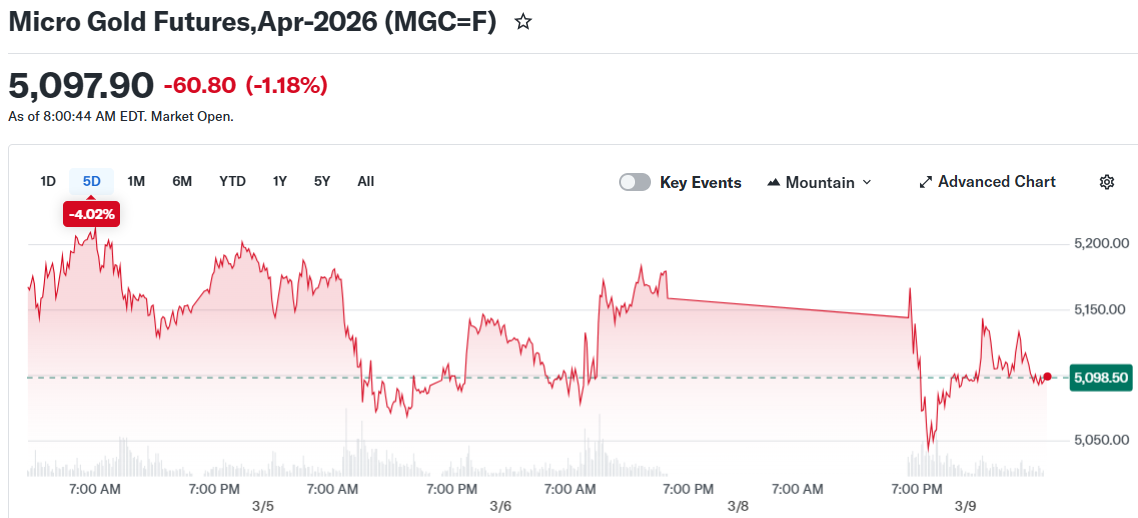
- Spot gold declined 1.5% to reach $5,096.51/oz on Monday, with a session low of $5,015.23/oz
- Brent crude’s surge toward $120/barrel sparked concerns about rising inflation, creating headwinds for gold
- The dollar index climbed as much as 0.7%, adding pressure to precious metal prices
- Despite the decline, gold maintains its position above $5,000/oz with year-to-date gains near 18%
- Other precious metals including silver, platinum, and palladium posted losses, though silver recovered partially
Precious metals experienced significant downward pressure on Monday as escalating conflict between US-Israel and Iran moved into its tenth day, triggering a dramatic rally in crude oil markets and strengthening the dollar — both factors that challenged gold’s recent momentum.
The spot price for gold declined 1.5% to settle at $5,096.51/oz during mid-morning trading in London. During the session’s weakest point, prices touched $5,015.23/oz, briefly flirting with a breakdown below the psychological $5,000 threshold. Meanwhile, gold futures contracts retreated 1.1% to $5,104.04/oz.
The market downturn coincided with a dramatic 30% spike in Brent crude prices, which briefly approached the $120 per barrel mark. This followed weekend military strikes by US and Israeli forces targeting Iranian oil infrastructure. Tehran retaliated by launching attacks on maritime vessels transiting the Strait of Hormuz, a critical chokepoint responsible for approximately 20% of worldwide oil transportation.
The dramatic oil spike quickly shifted investor attention toward potential inflationary consequences and their implications for monetary policy.
Rising Inflation Concerns Shift Federal Reserve Outlook
Elevated crude oil prices ripple through the broader economy, increasing costs across multiple sectors and potentially accelerating inflation. This scenario diminishes expectations for Federal Reserve interest rate reductions — and could even raise the possibility of rate increases. Gold, which generates no yield, typically underperforms when interest rates are anticipated to remain elevated or increase further.
The Bloomberg Dollar Spot Index advanced 0.3% on Monday, building on the previous week’s 1.3% gain. Dollar strength makes gold more costly for international purchasers, compounding downward price pressure.
“In periods of geopolitically driven market stress, investors sometimes sell assets such as gold to raise cash,” said Christopher Wong, strategist at Oversea-Chinese Banking Corp. “Once that phase passes, geopolitical uncertainty typically continues to underpin demand for safe havens on dips.”
This dynamic tension — between safe-haven demand and interest rate concerns — has characterized gold’s volatile trading patterns throughout recent weeks. The precious metal has oscillated within a range from $5,000/oz to near-record highs approaching $5,600/oz established in late January.
The previous week saw gold retreat approximately 2%. While Friday’s disappointing US employment data temporarily boosted expectations for rate cuts, the subsequent oil market surge rapidly eclipsed that optimism.
Broader Precious Metals Sector Faces Headwinds
Silver prices momentarily dropped beneath the $80/oz level before staging a partial recovery. The metal concluded Monday’s trading session down 0.9% at $83.82/oz. Platinum experienced a 1.8% decline while palladium shed 1.7%. Copper futures decreased 0.7% to $12,781.0 per ton.
Notwithstanding Monday’s setback, gold has maintained approximately 18% gains year-to-date. Sustained purchasing activity from central banks has provided consistent support, notably with the People’s Bank of China extending its gold acquisition streak to sixteen consecutive months through February.
Ed Meir, an analyst with Marex, noted in a Friday commentary that a swift resolution to the conflict would likely pressure the dollar lower and support gold prices, whereas a protracted war would elevate both yields and the dollar on inflation expectations. Brent crude was trading approximately 12.5% higher during Monday’s session.
