




Key Takeaways
- Ethereum declined to approximately $2,130 following a peak at $2,390 earlier this week
- BitMine Immersion acquired 60,999 ETH, expanding total holdings to 4.59 million ETH
- Large holders are exiting long positions and initiating shorts as retail investors buy the dip
- Spot Ethereum ETFs in the US recorded net withdrawals totaling $192.1 million across two sessions
- The CME futures gap at $2,117 has been closed, with significant buy support establishing near $2,100
Ethereum launched the week with impressive upward momentum, surging to $2,390—marking its strongest price point since the beginning of February. The advance was fueled by institutional capital inflows, major holder accumulation, and heightened derivatives market engagement.
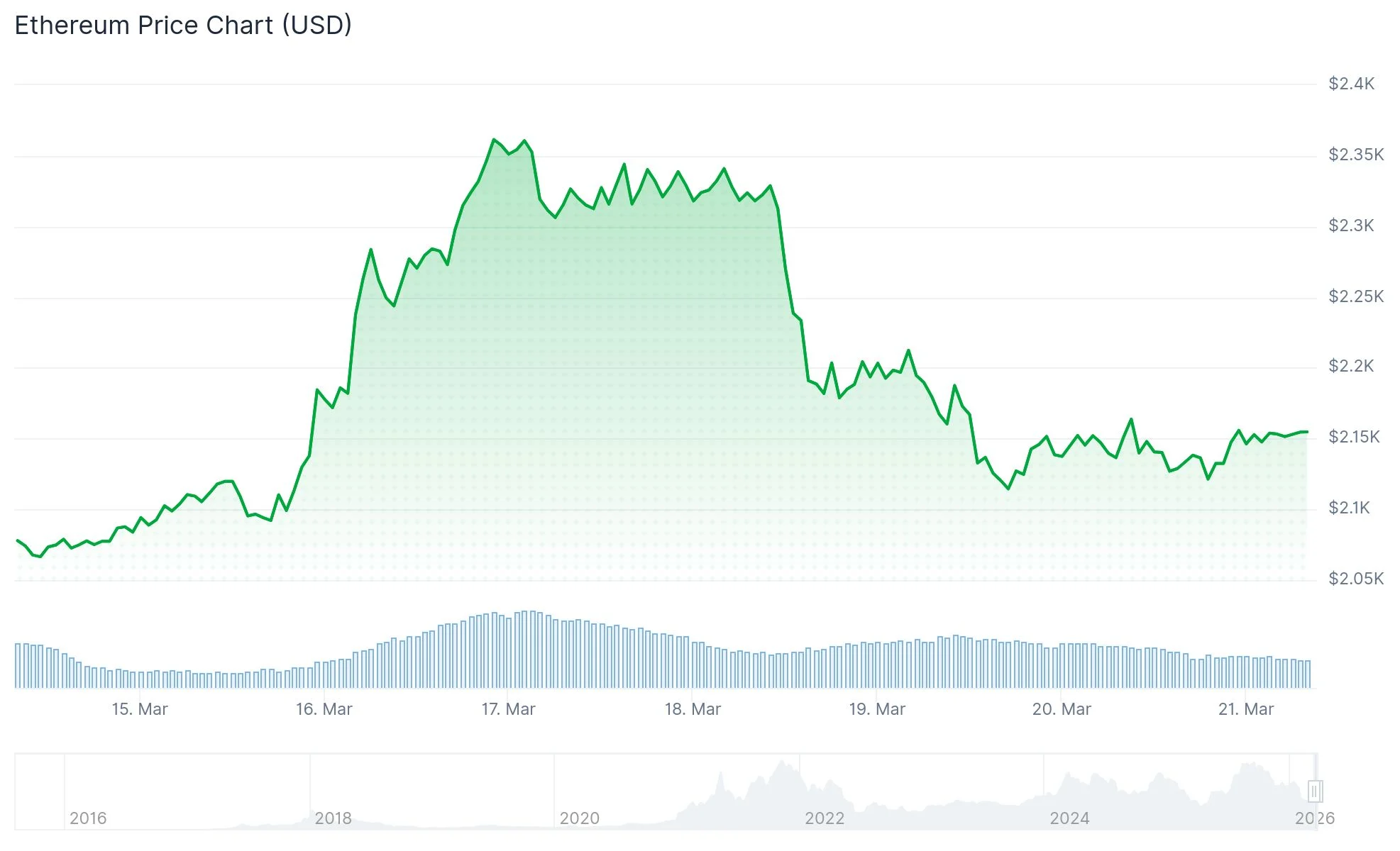
Early in the week, Ethereum treasury company BitMine Immersion (BMNR) announced the acquisition of 60,999 ETH, pushing its aggregate position to 4.59 million ETH. Simultaneously, open interest across ETH derivatives platforms reached levels not observed since September of the previous year.
However, the bullish trajectory encountered resistance. Escalating geopolitical instability in the Middle East triggered crude oil price spikes and dampened projections for monetary policy easing in 2026, creating headwinds for risk-sensitive assets across cryptocurrency markets.
ETH faced rejection near its realized price—the aggregate on-chain acquisition cost—hovering around $2,310. This threshold has historically served as a profit-taking zone during fragile uptrends, as breakeven holders opt to exit positions.
Institutional Money Exits After Six-Day Streak
U.S. spot Ethereum exchange-traded funds reversed course after recording six consecutive sessions of net inflows. Withdrawals totaling approximately $192.1 million across just two trading days intensified the bearish pressure on pricing.

Ethereum experienced $39 million in forced liquidations over a 24-hour window, with long positions accounting for $21.2 million of that figure, per data from Coinglass.
On-chain researcher Boris identified the emergence of a potential liquidity trap. During ETH’s approach toward $2,400, the Whale vs Retail Delta indicator shifted further into negative territory. Major holders were systematically closing bullish positions and establishing bearish ones, while smaller traders pursued the opposite strategy—accumulating aggressively.
Boris observed that although buying momentum remained robust temporarily, it was ultimately consumed by sell-side liquidity. The market has transitioned into a consolidation phase. Liquidation heatmaps reveal concentrated long exposure with critical vulnerability zones at $1,850 and lower.
Chicago Futures Gap Closed at $2,117
Market strategist CW verified that Ethereum has successfully closed its CME futures gap positioned at $2,117. A substantial buy wall has materialized around the $2,100 threshold, which coincides with the 0.382 Fibonacci retracement level. Should a rebound materialize from this zone, the subsequent upside target sits at $2,686.
Ethereum is presently challenging the $2,110 support region, which aligns with the 20-day exponential moving average. A decisive breach below this juncture could expose $1,740 as the next downside target, followed by $1,524. For bulls to regain control, ETH requires a daily closing price above $2,390 to validate a sustainable recovery trajectory.
The Relative Strength Index remains positioned near the neutral 50 mark, reflecting equilibrium with diminishing momentum.
Cryptocurrency analyst Ted shared his perspective on X: “$ETH bounced back from its $2,100 support zone. The move is looking a bit weak, as spot buyers aren’t here. This means Ethereum could drop below the $2,100 level again given rising macro uncertainty and low institutional demand.”
Current market conditions show ETH maintaining a precarious position just above $2,100, with ETF redemptions persisting and macroeconomic pressures from Middle Eastern geopolitical developments remaining unresolved.
