




TLDR
- Bitcoin approached $70,000 resistance but retreated to $68,300, unable to sustain the breakout attempt.
- Alternative cryptocurrencies outshined Bitcoin, with Cardano climbing 10.8%, Ether gaining 8.5%, and Dogecoin rising 8.3%.
- Nvidia surpassed Q4 earnings forecasts but surrendered most after-hours gains following the announcement.
- Stablecoin supply plateaus and broader macroeconomic headwinds continue hampering crypto’s rebound prospects.
- Bitcoin dropping beneath $60,000 could spark a wave of liquidations potentially driving prices toward $47,000.
Bitcoin made a brief attempt at the $70,000 level on Wednesday, only to retreat to approximately $68,300 during Thursday’s early trading session. This represented a significant 5% decline from the peak to the overnight bottom of $67,700.
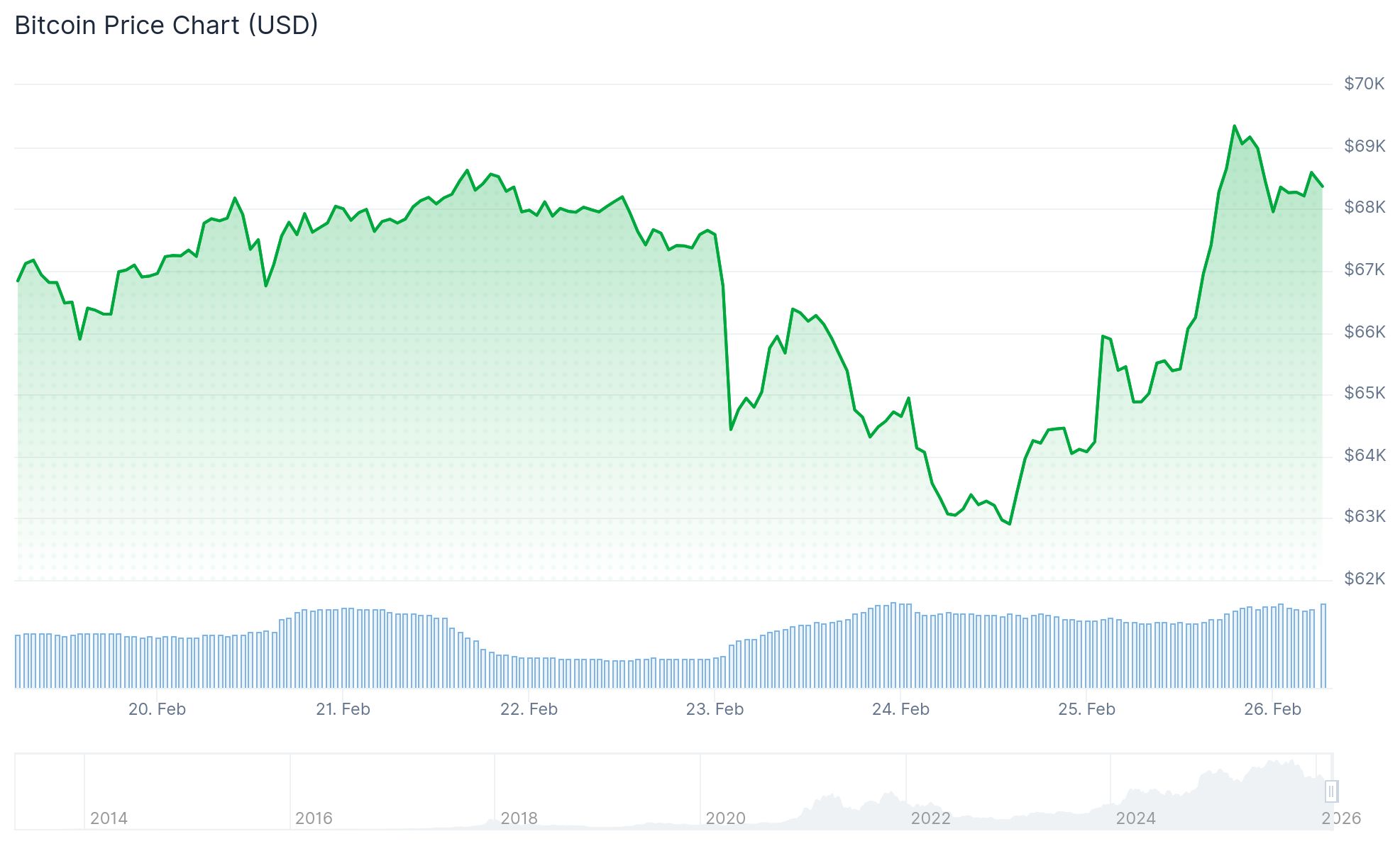
The rally marked Bitcoin’s most serious challenge to the $70,000 barrier since the sharp downturn on February 5, yet failed to produce a decisive breakthrough.
Alternative cryptocurrencies painted a considerably brighter picture. Among the top 10 digital assets, Cardano dominated with a 10.8% surge, while Ether climbed 8.5%, Dogecoin advanced 8.3%, and Solana rose 6.9%. Bitcoin’s 4.3% increase ranked among the weakest performances in the large-cap category.
Such performance gaps typically signal a revival in risk-taking behavior. Market participants often shift capital into more volatile altcoins when confidence returns that a correction has bottomed out.
Daniel Reis-Faria, CEO of ZeroStack, said in an email: “The wave of forced selling is starting to clear out. Altcoins are outperforming again, and more of them are ahead of Bitcoin. That tells me we’re seeing a rotation.”
Nvidia Earnings Momentum Quickly Evaporates
In equity markets, Nvidia delivered Q4 financial results that exceeded analyst projections for both earnings and sales. The announcement temporarily eased concerns surrounding the so-called “AI scare trade” that has pressured markets throughout the year.
However, the positive sentiment proved short-lived. Nvidia stock surrendered nearly all its post-announcement advance during after-hours trading, finishing up a mere 0.2%. Nasdaq 100 futures declined 0.3% following the earnings release.
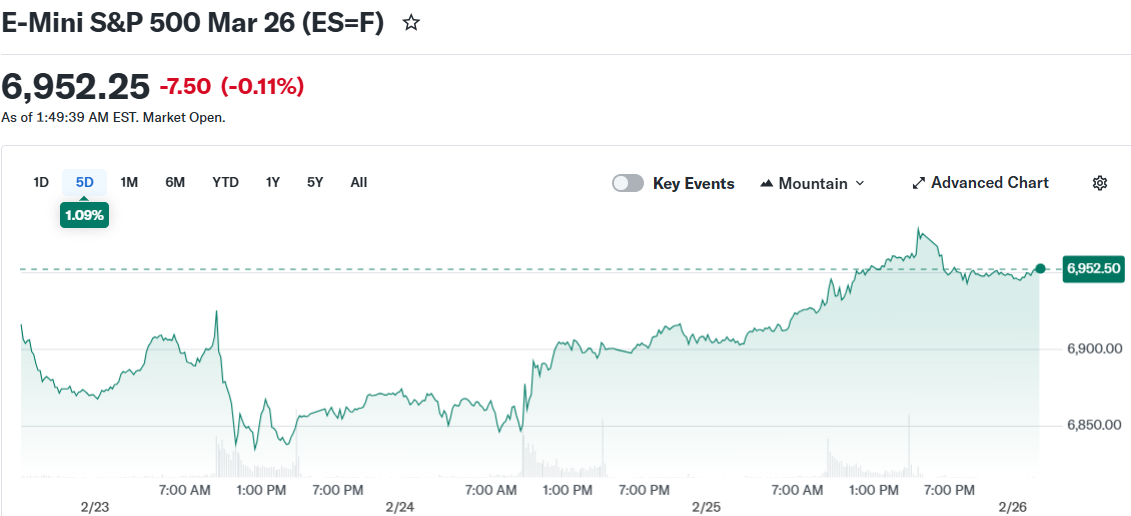
The S&P 500 recorded its second consecutive positive session during Wednesday’s regular trading hours. Both the Nasdaq Composite and Dow Jones Industrial Average also closed higher.
Salesforce declined approximately 5% in after-hours activity, extending a downtrend that has resulted in a roughly 28% year-to-date loss. Technology and software equities had otherwise spearheaded the recovery during standard market hours, with Oracle and every member of the Magnificent Seven recording advances.
President Trump, during his State of the Union remarks, indicated expectations that Big Tech companies will bear responsibility for escalating electricity costs associated with data center operations.
Macroeconomic Headwinds Continue Pressuring Digital Assets
Market maker Wintermute observed that digital currencies have been declining in tandem with technology stocks as investors reallocate capital toward defensive and physical assets.
Crypto finance platform Matrixport identified stablecoin supply stagnation as a significant barrier to Bitcoin’s advancement. Onchain analytics firm Glassnode projected that overall market liquidity may require six months or longer to fully normalize.
Cryptoquant data indicates that selling pressure has diminished on Binance, supporting the possibility of a near-term recovery. Nevertheless, digital asset exchange Bitrue cautioned that Bitcoin falling below $60,000 could drive prices toward the $50,000–$55,000 range, or potentially as low as $47,000 should forced liquidations intensify.
Market participants will also monitor Thursday’s weekly jobless claims data and Friday’s January producer price index release. Corporate earnings announcements are scheduled from Dell Technologies, Warner Bros. Discovery, and CoreWeave.
