




TLDR
- Crude prices declined more than 1% Monday following progress in US-Iran nuclear negotiations
- President Trump increased import tariffs from 10% to 15% following Supreme Court ruling against his initial approach
- Geneva will host the third session of US-Iran negotiations on Thursday
- Goldman Sachs upgraded its 2026 Brent price target to $64 per barrel from $56
- Goldman projects a 2.3 million bpd oversupply in 2026, with potential downside if Iran or Russia sanctions are relaxed
Energy markets witnessed a decline exceeding 1% on Monday as traders digested two significant developments: escalating US tariff measures and advancing diplomatic efforts with Iran.
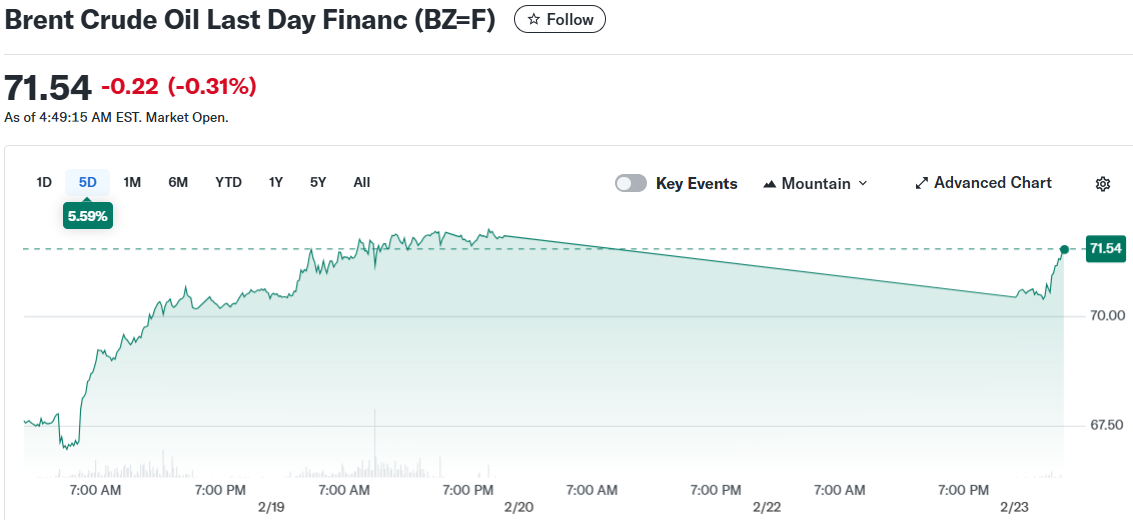
Brent crude declined 73 cents, settling at $71.03 per barrel. US West Texas Intermediate decreased 75 cents, closing at $65.73 per barrel.
The downturn followed President Trump’s declaration that import tariffs would increase from 10% to 15% across all US imports. This decision came after the Supreme Court invalidated his previous tariff framework. Trump invoked the International Emergency Economic Powers Act to implement the new rate — representing the ceiling permitted under this legislation.
Market participants expressed concern that elevated tariffs could dampen worldwide economic expansion and curtail petroleum consumption. The announcement simultaneously impacted crude oil, US stock index futures, and precious metals as capital fled risk-sensitive assets.
Iran Talks Ease Fear of Conflict
Diplomatic representatives will convene for a third round of US-Iran nuclear discussions on Thursday in Geneva. Oman’s Foreign Minister announced the upcoming session on Sunday.
During the previous week, both Brent and WTI surged more than 5% amid concerns about potential military confrontation with Iran. Monday’s diplomatic developments helped reverse those gains.
A high-ranking Iranian representative informed Reuters that Tehran is prepared to compromise on aspects of its nuclear activities. In exchange, Iran seeks elimination of sanctions and acknowledgment of its uranium enrichment rights.
As prospects for an agreement emerged, the geopolitical risk premium embedded in oil prices began dissipating. Market observers indicated that crude’s trajectory remains uncertain, though continued price swings appear probable.
Goldman Sachs Upgrades Oil Price Outlook
Goldman Sachs elevated its crude price projections in research released Sunday. The investment bank now anticipates Brent will average $64 per barrel throughout 2026, revised upward from its prior $56 estimate. WTI is now projected to average $60, increased from $52.
For the fourth quarter of 2026 particularly, Goldman increased its Brent projection by $6 to $60 and WTI by $6 to $56. The institution attributed the revision to reduced OECD stockpile levels.
Goldman maintained its 2026 supply surplus projection at 2.3 million barrels daily, operating under assumptions of no significant supply interruption and no Russia-Ukraine peace agreement.
The bank reduced its supply projections for Kazakhstan, Venezuela, Iran, and Iraq following these nations’ failure to meet production objectives. It elevated forecasts for the Americas and core OPEC members possessing spare production capability.
Goldman anticipates OPEC+ will begin incrementally expanding output during Q2 2026. The firm also highlighted downside risks of $5 for Brent and $8 for WTI should sanctions relief for Iran or Russia release additional supply.
Goldman projects Brent and WTI will climb to $70 and $66 respectively by December 2027.
