



TLDR
- Citi maintains its S&P 500 year-end forecast of 7,700 amid heightened uncertainty
- Projected index earnings of $320 for 2026, initially seen as aggressive, now appear cautious
- Middle East tensions involving Iran represent the most pressing near-term concern
- Additional headwinds include AI-driven market disruption, private credit vulnerabilities, and trade policy uncertainty
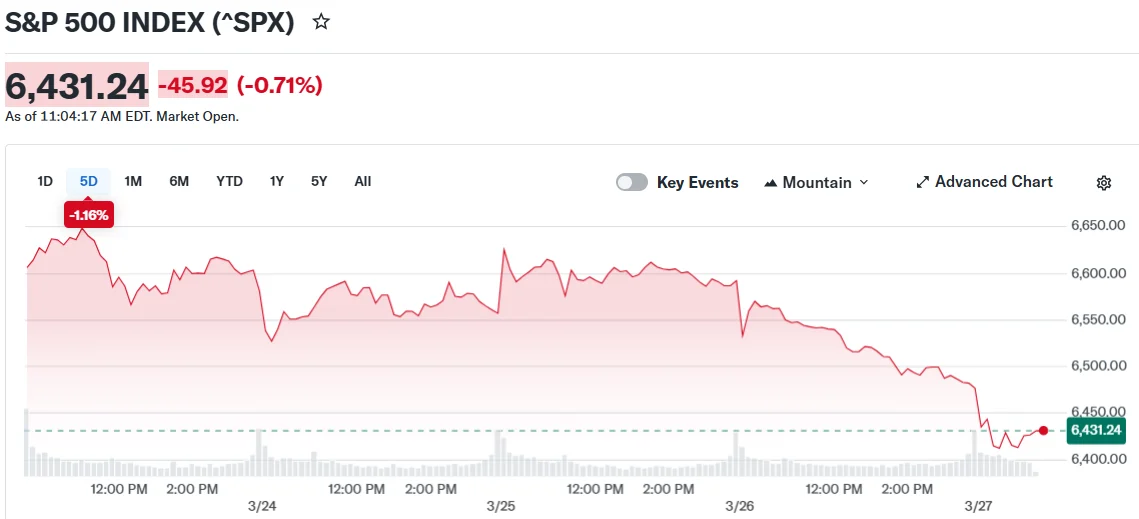
- The benchmark index has declined roughly 6.7% in 2026, currently trading around 6,417
Despite mounting challenges to what the investment bank describes as an ideal economic environment, Citi has reaffirmed its S&P 500 year-end price objective of 7,700.
The projection hinges on anticipated per-share earnings of $320 for 2026. While this figure appeared optimistic when first announced, Citi now characterizes it as modest following robust fourth-quarter corporate results that pushed 2025 full-year earnings to approximately $276.
Current bottom-up market consensus sits at $321.3, marginally surpassing Citi’s internal projection.
The financial institution has outlined two supplementary forecasts. An optimistic scenario projects 8,300, driven by accelerated earnings expansion and elevated valuation multiples. A pessimistic scenario anticipates 5,700, reflecting deteriorating fundamentals and compressed valuations.
With the S&P 500 hovering around 6,417, achieving the baseline target would necessitate approximately 20% appreciation from present levels.
The benchmark has shed roughly 6.7% year-to-date, as large-cap technology leaders relinquished substantial portions of their previous year’s outperformance.
Geopolitical and Macro Risks
Citi’s equity strategy team, headed by Scott Chronert, identified escalating tensions with Iran as the most acute near-term threat. Sustained conflict could drive energy prices higher, potentially dampening household consumption and neutralizing any positive impact from expansionary fiscal measures.
The analysts also highlighted emerging concerns around artificial intelligence-driven market displacement, stress indicators within private credit markets, and persistent ambiguity surrounding international trade relations and tariff implementation.
Nevertheless, Citi indicated it would not be adjusting its forecasts at this time. “We maintain our full year targets for now,” the institution confirmed.
Regarding monetary policy, Citi’s economics division anticipates the Federal Reserve will implement three quarter-point rate reductions between June and September, lowering the target range to 2.75–3.0% by year-end.
Economic output is projected to show modest year-over-year acceleration initially before decelerating during the latter portion of the year.
Earnings and Market Breadth
The Information Technology sector has experienced the most substantial upward earnings estimate revisions, with 2026 projections increasing more than 11% since the beginning of January.
The Elite 8 mega-capitalization companies continue to dominate S&P 500 earnings revision momentum. However, Citi observes that the broader market universe is now making more meaningful contributions.
The remaining 492 constituents are forecast to deliver low-double-digit earnings expansion in 2026, following their emergence from an earnings contraction during 2024.
Since the start of 2026, the Elite 8 cohort has declined approximately 10% while the overall index has registered a modest positive return. This marks a dramatic shift from 2025, when mega-caps delivered roughly 25% returns compared to 14% for the remainder of the market.
Smaller-capitalization indices have demonstrated greater resilience, with small-cap and mid-cap benchmarks advancing more than 3% and 4% respectively in 2026.
Citi’s Levkovich sentiment indicator currently registers at the upper boundary of its neutral territory.
The S&P 500 stands near 6,417, representing an approximately 6.7% year-to-date decline.
