




TLDR
- Brent crude has surged past the $100 per barrel threshold following Iran’s commitment to maintain its blockade of the Strait of Hormuz.
- The International Energy Agency has declared this the most significant supply disruption ever recorded and authorized the release of 400 million barrels from strategic stockpiles.
- A temporary exemption from the US Treasury permits select nations to purchase Russian crude, effective through April 11.
- Intelligence reports indicate Iran has started deploying naval mines throughout the strait, significantly escalating risks for maritime traffic.
- Plans are underway for US Navy convoy operations through the strait starting late March, though analysts remain skeptical about its effectiveness in resolving the crisis.
Global energy markets experienced significant upheaval this week as Brent crude oil breached the $100 per barrel mark, driven by Iran’s declaration that it will maintain its closure of the Strait of Hormuz, triggering widespread concerns across international equity markets.
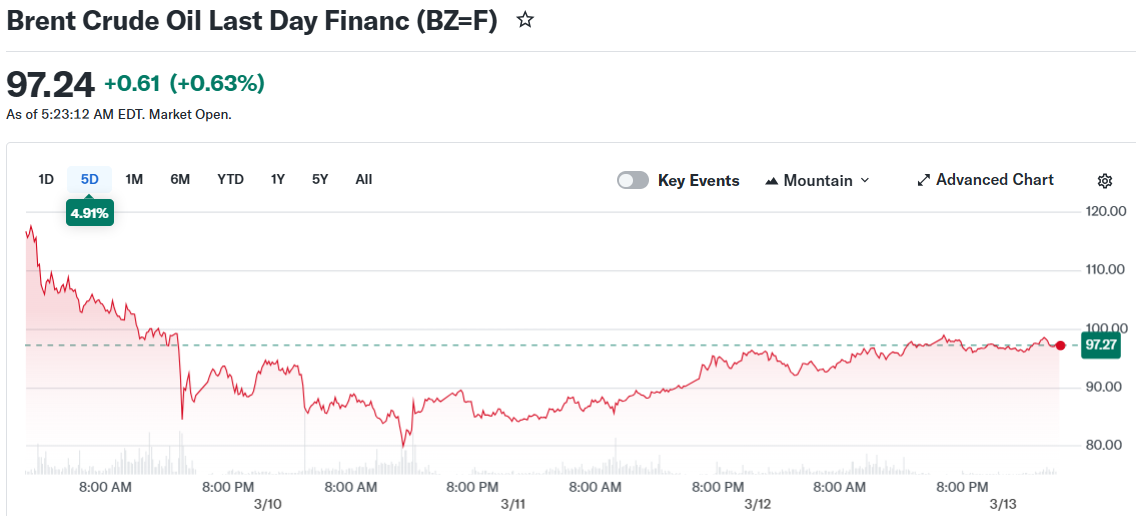
The dramatic price increase comes amid extraordinary market volatility not witnessed in recent years. West Texas Intermediate approached $97 per barrel, with both major oil benchmarks experiencing price fluctuations of magnitudes unseen since the COVID-19 pandemic disruptions.
Mojtaba Khamenei, Iran’s newly installed supreme leader, delivered his inaugural public address following his ascension after his father’s death. During this appearance, he confirmed Iran’s intention to continue blocking maritime access through the strategic waterway.
The Strait of Hormuz represents a critical chokepoint situated between Iranian and Omani territories. Approximately 20% of global petroleum supplies traverse this narrow passage. Since hostilities between the US-Israel coalition and Iran commenced on February 28, maritime traffic through the strait has ground to a virtual standstill.
The International Energy Agency characterized the current situation as unprecedented in scale, surpassing all previous oil supply crises. In response, the organization coordinated an extraordinary drawdown of 400 million barrels from strategic petroleum reserves maintained by member nations.
According to reporting by the New York Times, which cited American intelligence officials, Iran has initiated mine-laying operations within the strait’s waters. This development significantly compounds the hazards facing commercial vessel operators attempting passage.
US Energy Secretary Chris Wright indicated that naval escort operations for commercial tankers could commence before March concludes. Earlier claims on social media suggesting successful convoy operations had already occurred were subsequently retracted by White House officials.
US Eases Russia Oil Sanctions
In an effort to alleviate market tensions, the US Treasury Department announced a limited exemption permitting specific nations to accept deliveries of Russian crude oil that had been loaded aboard vessels prior to March 12. This provisional measure remains valid until April 11.
Treasury Secretary Scott Bessent characterized the decision as necessary for maintaining equilibrium in worldwide energy markets. Russian officials reported approximately 100 million barrels of petroleum currently in maritime transit.
The United Kingdom announced it would not replicate the American approach to Russian energy sanctions. British Energy Minister Michael Shanks expressed concerns that such measures could provide Moscow with additional resources to finance military operations.
French President Emmanuel Macron challenged the logic of the sanctions relief, arguing that the Hormuz crisis does not warrant accommodating Russian exports. Ukrainian President Zelensky characterized the policy shift as a “serious blow” to Ukrainian interests.
Markets and Prices
Stock markets experienced downward pressure throughout the week as petroleum prices escalated. The exceptional volatility has been amplified by derivative trading activity and exchange-traded fund repositioning.
WTI crude experienced intraday fluctuations spanning approximately $43 this week, representing the widest trading range since oil futures briefly turned negative during pandemic lockdowns. Brent crude similarly oscillated across a roughly $38 bandwidth.
Asian economies, which maintain substantial dependence on Persian Gulf petroleum imports, have responded with urgency. Government officials in Japan, South Korea, and Thailand have implemented gasoline price controls. The Philippines, which sources roughly 95% of its crude from Middle Eastern suppliers, mandated compressed work schedules for government employees to reduce fuel consumption.
Market analysts suggest a trading band between $85 and $105 per barrel represents a realistic expectation while the geopolitical conflict continues. While the IEA’s strategic reserve deployment may provide temporary market support, industry experts caution it will prove insufficient for sustained price stabilization.
President Trump stated via social media that preventing Iranian nuclear weapons development remains his paramount concern, superseding considerations about petroleum pricing.
