




TLDR
- Bank of America increased its 2026 Brent crude oil projection to $77.50/barrel from a previous $61 estimate
- At publication time, Brent crude was trading at $103 per barrel
- Approximately 200 million barrels have been withdrawn from worldwide markets since the Strait passage ceased
- The investment bank elevated price targets for American E&P firms by roughly 17% across the board
- Top recommendations feature Diamondback Energy (FANG), Devon Energy (DVN), and Ovintiv (OVV)
Bank of America has adjusted its Brent crude oil price outlook for 2026 following supply disruptions through the Strait of Hormuz that have constrained worldwide petroleum availability faster than analysts anticipated.
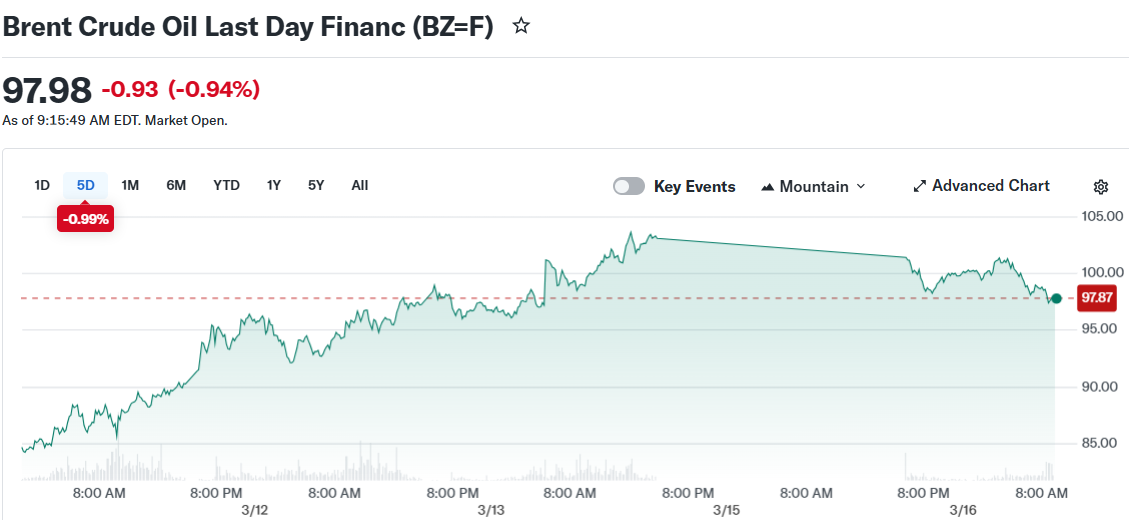
The financial institution now projects Brent will reach an average of $77.50 per barrel throughout 2026, marking a substantial increase from its previous $61 projection. Current trading showed Brent at $103 per barrel.
This forecast adjustment stems from an almost complete cessation of petroleum transport through the Strait of Hormuz, which represents one of the planet’s most vital energy transit points. Approximately 20 million barrels daily of crude oil and processed petroleum products typically flow through this waterway.
According to BofA, maritime traffic “stopped dead, almost two weeks ago.” Backup pipeline systems routing to the Red Sea have proven inadequate to compensate for the missing volume.
The impact has materialized rapidly. Close to 200 million barrels of crude have been withdrawn from worldwide reserves. This represents approximately half of the 400 million-barrel stockpile expansion documented during the previous year, eliminated within mere weeks.
BofA’s revised outlook presents several scenarios based on potential conflict trajectories. Should petroleum transport resume normalcy by April, Brent is projected to maintain a yearly average near $70. Should the interruption continue through Q2, that average rises to $85.
A third possibility — which the bank considers improbable — envisions Brent averaging approximately $130 per barrel should disruptions extend into 2026’s latter half.
What Happens When the War Ends?
BofA anticipates markets will shift back into oversupply territory following the conflict’s conclusion, bringing Brent down toward $65 during 2027. This forecast presumes no permanent supply damage.
“With no end to the war in sight, oil stockpiles are draining, and firming the fundamental outlook post-war,” wrote analysts under Kalei Akamine’s leadership.
The institution also elevated its mid-cycle oil price baseline to $70 Brent from $65, positioning it near the center of its $60–$80 extended-term commodity range.
A companion analysis from BofA analyst Mensah indicated that the petroleum price surge might trigger increased capital spending throughout the energy industry, as corporations adjust their investment strategies.
E&P Stocks Get a Boost
The improved oil pricing environment has translated directly into enhanced valuations for American exploration and production companies. BofA elevated price objectives for oil-exposed E&P stocks by approximately 17% on average.
Diamondback Energy (FANG) continues as BofA’s preferred selection among large-capitalization options.
Devon Energy (DVN) and Ovintiv (OVV) were identified as mid-cap alternatives positioned for valuation improvements given present oil pricing.
BofA also maintained its Buy recommendation on California Resources (CRC), highlighting its capital-efficient 2026 strategy and a possible modest output expansion in its 2027 maintenance framework.
