




Contents
Key Takeaways
- On April 8, Covenant AI publicly announced its withdrawal from Bittensor, citing centralized governance by co-founder Jacob Steeves
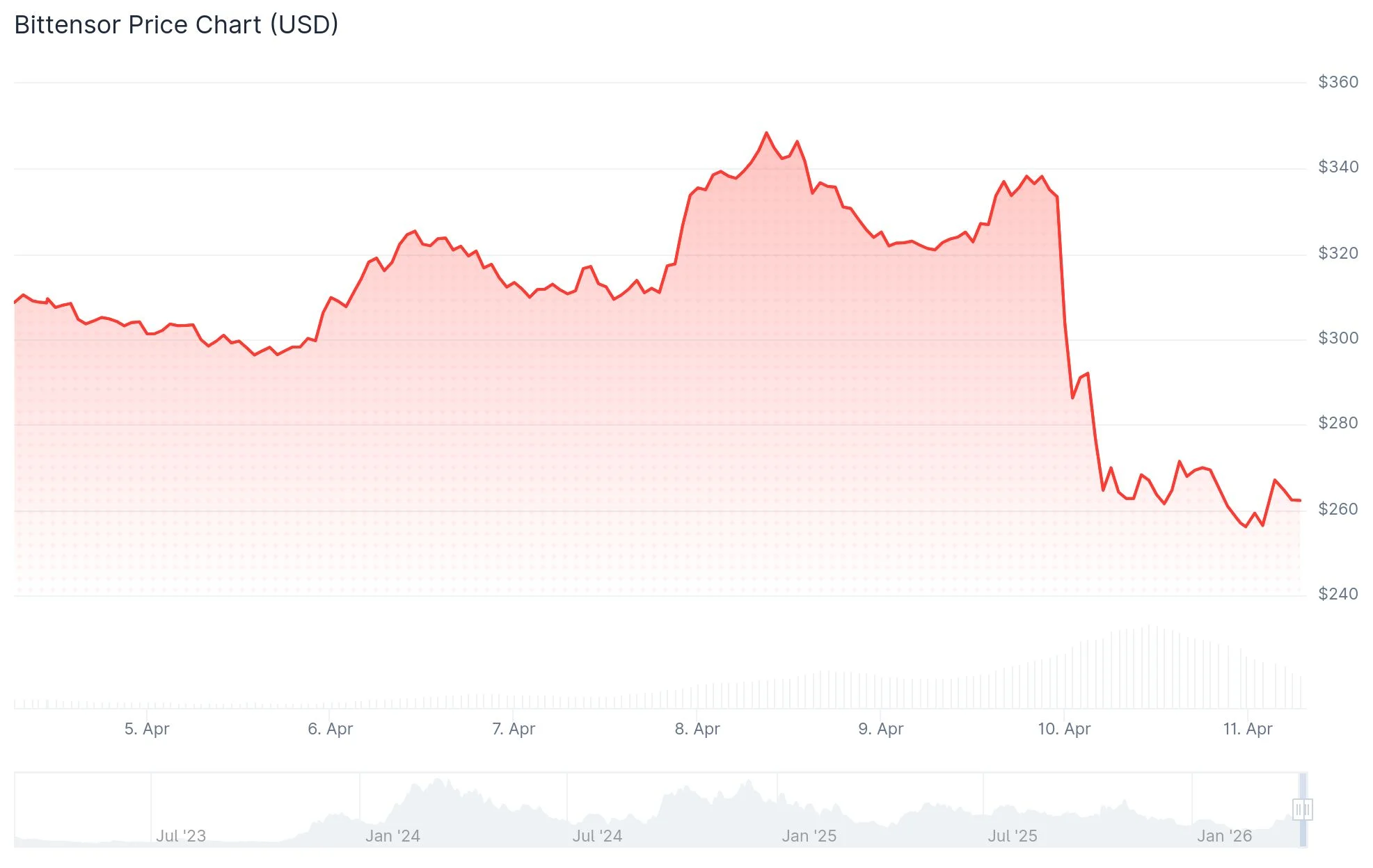
- TAO experienced a steep decline of approximately 25–30%, sliding from $337 to the $249–$253 range
- The selloff eliminated more than $650 million in market capitalization, triggering $9.1 million in leveraged long liquidations
- Daily trading activity exploded to $1.72 billion on April 10, dramatically exceeding the month’s typical $500 million baseline
- Chart patterns suggest TAO could face an additional 25–45% correction, potentially reaching the $144–$230 zone
The Bittensor protocol’s native cryptocurrency TAO experienced a significant downturn this week following explosive claims from a prominent subnet operator regarding centralized governance practices.
On April 8, Covenant AI made public its complete withdrawal from the Bittensor ecosystem. Two days following the initial announcement, founder Sam Dare released an extensive statement detailing the motivations behind the organization’s departure.
Dare’s accusations centered on claims that co-founder Jacob Steeves maintains singular, centralized authority over the protocol’s operations. This represents a fundamental contradiction to Bittensor’s foundational promise as a decentralized, open AI network where independent subnets operate with equal competitive opportunity.
The specific grievances outlined by Dare included accusations that Steeves independently halted a subnet’s emission rewards, superseded the decision-making authority of subnet owners within their designated governance forums, and removed projects from the ecosystem without adhering to established procedural frameworks.
Perhaps most damaging, Dare claimed that Steeves deployed substantial, high-profile token liquidations as “punitive” mechanisms to enforce compliance during operational disputes. “These actions were not the result of transparent governance consensus,” Dare stated. “They represented unilateral decisions by a single individual who never truly decentralized control.”
Dare further alleged that other members of the project’s leadership triumvirate function primarily as “legal protection” while Steeves operates without meaningful accountability.
How Markets Responded
TAO experienced an approximately 25% collapse within a six-hour window following the revelations, plummeting from $337 down to $253. The rapid decline wiped out more than $650 million in market capitalization, reducing the total to $2.57 billion.
On April 10, trading volume surged to $1.72 billion, substantially exceeding the approximately $500 million daily average recorded in the month’s earlier sessions. The selloff coincided with a volume increase of roughly 250%, indicating widespread market engagement in the downward movement.
Within derivatives markets, leveraged long positions worth $9.1 million were forcibly closed, accounting for $9.71 million of total liquidations that predominantly impacted bullish speculators. Numerous traders maintaining optimistic positions were adversely positioned, intensifying the downward selling pressure.
TAO has experienced a modest recovery from its lows but continues to trade down 12.8% across the previous seven-day period. The token maintains a 37% gain over the trailing 30 days.
Chart Analysis
TAO is presently trading within the 0.382–0.5 Fibonacci retracement band. During November 2025, a breakdown from this identical zone resulted in a decline exceeding 30%. A comparable configuration in June 2025 saw TAO find stability around the 0.618 Fib level before initiating a recovery.
Potential Support Levels
Should the June 2025 price action repeat, TAO may decline toward the 0.618 Fibonacci support level positioned near $230. If the November 2025 pattern materializes instead, the 1.0 Fibonacci target rests near $144, representing approximately 45% downside from present price levels.
On April 10, trading volume reached $1.72 billion, marking the highest single-day activity recorded this month.
