



Key Highlights
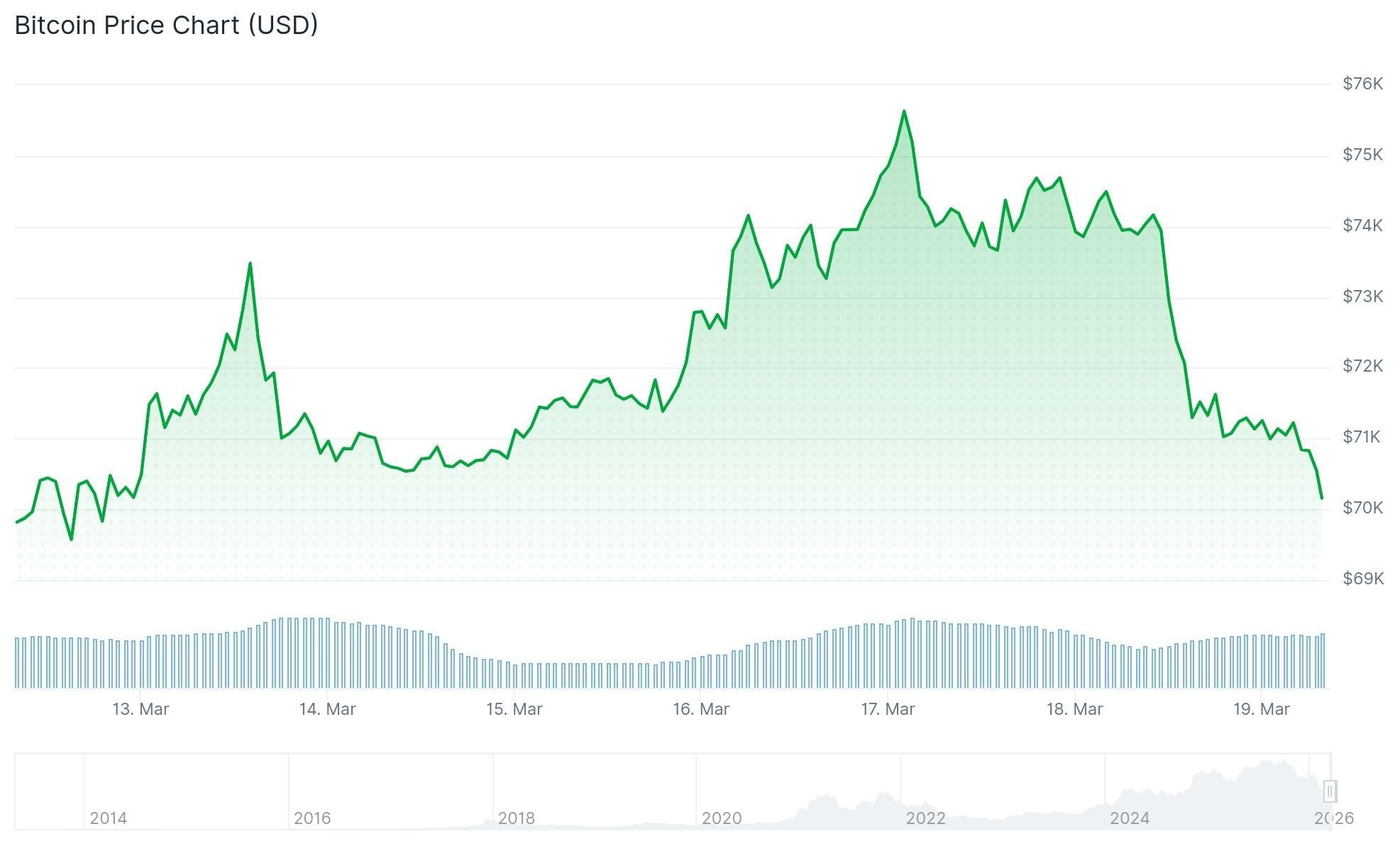
- Bitcoin slipped beneath the $70,000 threshold following the Federal Reserve’s decision to maintain current interest rates with only one anticipated cut in 2026.
- The Federal Reserve increased its inflation projection for 2026 to 2.7%, pointing to escalating crude oil costs fueled by Middle Eastern tensions.
- Oil prices jumped beyond $110 per barrel following Iranian strikes on regional energy infrastructure.
- Veteran Bitcoin holders offloaded more than 1,650 BTC, totaling approximately $117 million in value.
- Widespread declines hit cryptocurrency, equity, and gold markets, with the Nasdaq dropping 1.5% and Ether falling over 6%.
Bitcoin (BTC) experienced a significant downturn this week, dipping below the $70,000 mark after the Federal Reserve maintained its current interest rate policy while indicating a more gradual pace of future rate reductions than market participants anticipated.
The central bank maintained its policy rate within the 3.5%–3.75% corridor. However, market participants found greater cause for concern in the messaging delivered during Fed Chair Jerome Powell’s subsequent media briefing.
Powell highlighted surging oil markets as an emerging inflationary threat. “The oil shock for sure shows up,” he noted, acknowledging its influence on the Federal Reserve’s economic projections.
The central bank revised its 2026 inflation outlook upward to 2.7%, compared to its previous 2.4% projection. This adjustment rattled market participants who had anticipated continued disinflation.
The Federal Reserve’s “dot plot,” which illustrates policymakers’ rate expectations, now indicates a median projection of just one rate reduction in 2026. Merely a month earlier, markets had priced in two to three cuts.
Activity on Polymarket and CME Fed funds futures shifted rapidly. The likelihood of a single rate cut this year surged to approximately 80%, climbing from just 38% probability a month ago.
Energy Market Volatility Adds Strain
Oil prices had been climbing even before the Federal Reserve convened. Crude prices exploded past $110 per barrel after Iranian forces targeted energy infrastructure throughout the Middle East, following an attack on its South Pars natural gas complex.
Elevated oil prices drove bond yields higher and bolstered the U.S. dollar, which typically pressures risk-oriented assets such as Bitcoin.
The Bank of Japan similarly maintained its rate policy on Thursday and identified the Middle Eastern conflict as a potential threat to Japan’s inflation trajectory.
Bitcoin had been changing hands above $74,000 earlier in the week, momentarily approaching $76,000. By Thursday morning, it had declined to approximately $70,817, representing roughly a 4.2% decline over 24 hours.
Ether plummeted over 6%, while XRP, Solana, and Dogecoin all registered declines ranging from 3%–5%. The CoinDesk 20 Index contracted 3%.
Early Bitcoin Holders Liquidate Over $117 Million
On-chain analytics monitored by Lookonchain revealed that at least two veteran Bitcoin holders liquidated positions during the downturn.
One early adopter who had previously liquidated an 11,000 BTC position sold an additional 650 BTC. Another veteran holder with a 5,000 BTC portfolio liquidated the entirety of a 1,000 BTC holding.
Combined, these two addresses sold over 1,650 BTC valued at more than $117 million.
Cryptocurrency-linked equities also suffered substantial losses. Strategy (MSTR) and Bitmine (BMNR) declined 5%–6%. Galaxy (GLXY) dropped nearly 7%, and Gemini (GEMI) plunged 15%, reaching its lowest valuation since its public debut.
Gold extended its retreat as well, falling 3.1% to below $4,850 per ounce — its weakest pricing in over a month.
Powell rejected comparisons to 1970s stagflation scenarios, emphasizing that unemployment remains near historical norms and inflation sits only marginally above the central bank’s target. Markets are now anticipating a more restrictive monetary policy environment throughout the remainder of 2026.
