




Key Takeaways
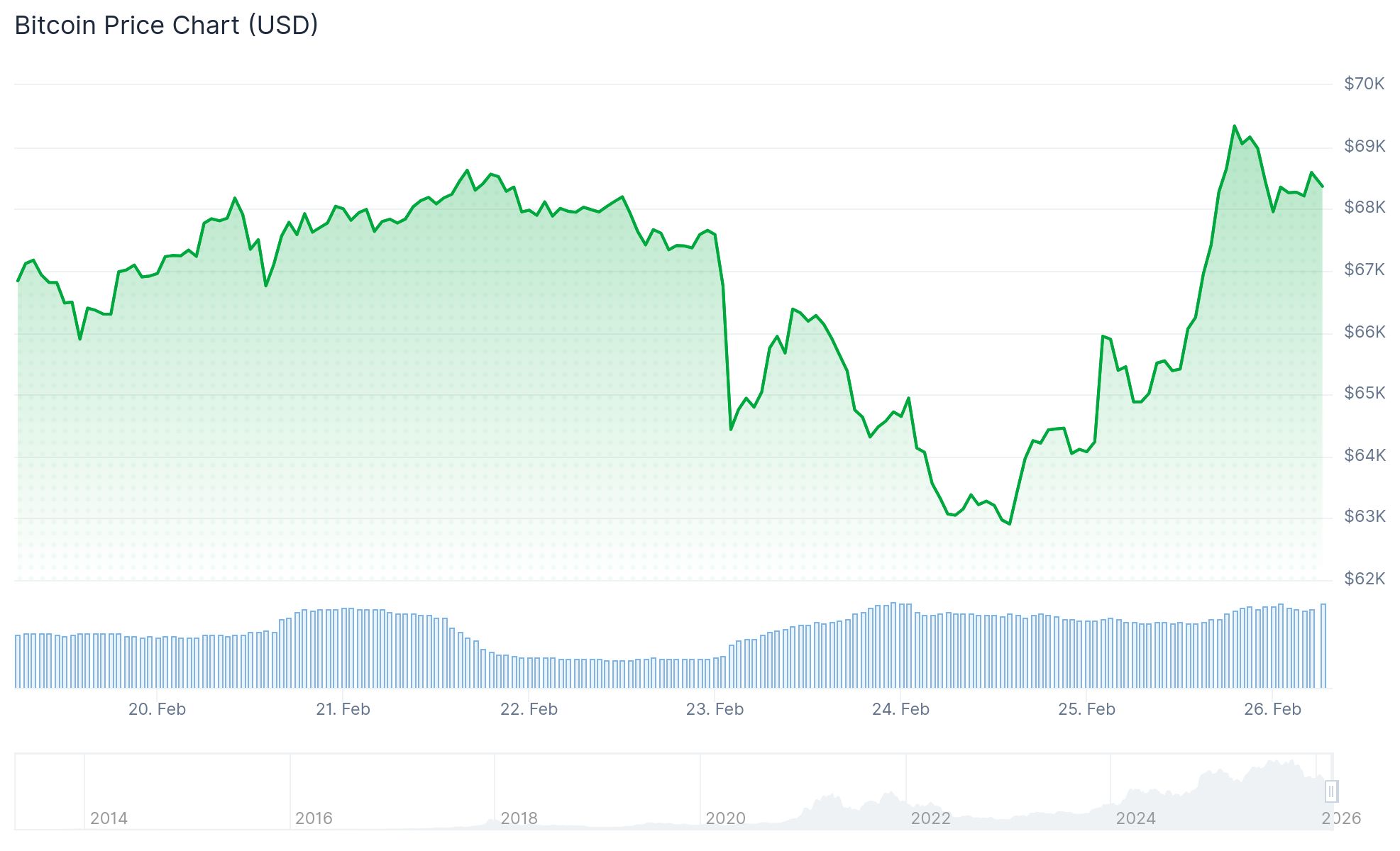
- Investment firm Stifel Financial forecasts Bitcoin may decline to $38,000, representing a 43% decrease from current trading levels around $65,000
- The projection relies on a 15-year trend analysis connecting the trough of each significant Bitcoin market collapse dating back to 2010
- Bitcoin now shows a 0.78 correlation with the Nasdaq 100, behaving similarly to technology equities rather than functioning as a protective asset
- Spot Bitcoin ETFs in the United States have experienced $3.8 billion in withdrawals across five weeks, with BlackRock’s IBIT accounting for $2.1 billion
- Optimistic analysts present competing forecasts between $170,000 (JPMorgan) and $250,000 (Fundstrat’s Tom Lee)
Stifel Financial, an investment banking institution with 136 years of operational history, has issued a forecast suggesting Bitcoin could retreat to $38,000. This projection represents a 43% decline from its present trading position near $65,000, and a dramatic 70% reduction from the October 2025 all-time high of $126,000.
The forecast originates from Barry Bannister, Stifel’s chief equity strategist. His research team constructed a trendline by connecting the nadir of each significant Bitcoin market crash beginning in 2010 and projecting it into the present.
The market downturns occurring in 2011, 2015, 2018, and 2022 exhibited varying magnitudes, yet the price floors consistently increased over successive cycles. This ascending trendline, when extrapolated to current timeframes, indicates a support level at $38,000.
Bitcoin experienced a 93% collapse in 2011, followed by 84% in 2015, and 83% in 2018. The 2022 downturn found support around $15,500. During each correction, committed long-term investors entered positions at progressively higher price points, establishing elevated support zones.
Stifel emphasizes this isn’t a guaranteed crash prediction. The firm notes that stabilizing factors which halted previous market crashes from penetrating deeper have yet to materialize.
Bitcoin Increasingly Mirrors Technology Stocks
Bitcoin was historically perceived as protection against dollar weakness. This dynamic has fundamentally shifted.
The Dollar Index declined almost 10% throughout 2025 and an additional 1% in early 2026, yet Bitcoin dropped concurrently rather than appreciating. Bannister characterizes this as the “Benjamin Button” phenomenon.
Bitcoin’s correlation coefficient with the Nasdaq 100 currently measures 0.78. When technology sector equities experience selling pressure, Bitcoin typically follows the same trajectory.
The Federal Reserve implemented modest rate reductions in December 2025 while maintaining hawkish guidance. Kevin Warsh’s appointment as Fed Chair suggests restrictive monetary policy will persist through 2027. Global M2 money supply is simultaneously contracting, diminishing the available capital for speculative market activities.
U.S. spot Bitcoin ETFs have registered $3.8 billion in net outflows spanning five weeks. BlackRock’s IBIT independently recorded $2.1 billion in withdrawals during this timeframe.
The CLARITY Act, legislation intended to provide institutional investors enhanced regulatory clarity, encountered obstacles in January following Coinbase’s withdrawal of support due to stablecoin yield provisions.
Bullish Perspectives on Bitcoin’s Trajectory
Stifel’s bearish outlook faces considerable opposition. JPMorgan projects Bitcoin ascending to $170,000 within a 6 to 12-month window, utilizing a volatility-adjusted comparison framework with gold.
Analyst Nikolaos Panigirtzoglou calculates Bitcoin is currently trading approximately $68,000 beneath its fair value when benchmarked against gold. He characterizes this as a quantitative analysis rather than a definitive prediction.
Fundstrat’s Tom Lee maintains a target range of $200,000 to $250,000 by year-end 2026. His thesis emphasizes the April 2024 halving event, which traditionally precedes price peaks occurring 12 to 18 months subsequently.
Arthur Hayes, former BitMEX chief executive, similarly anticipates Bitcoin surpassing $200,000, attributing his forecast to covert quantitative easing measures from the Federal Reserve through Reserve Management Purchases.
Historical bearish forecasts have frequently proven excessive. During 2022, market analysts cautioned of $10,000 levels, yet Bitcoin established its floor at $15,760.
Stifel designates $54,000 as the critical breakdown threshold. A decline through this price point could facilitate movement toward $45,000, subsequently opening the pathway to $38,000. Conversely, a rally exceeding $58,000 to $60,000 would undermine the bearish scenario.
Bitcoin currently trades near $65,000, with $3.8 billion in ETF capital flight documented across the previous five weeks.
