




Key Highlights
- Ethereum tumbled beneath $2,300 following the Federal Reserve’s decision to maintain rates between 3.50–3.75% with hawkish commentary.
- Exchange deposits surged by 226,000 ETH over a three-day period, suggesting heightened sell-side pressure.
- Major wallets connected to Fenbushi Capital, Genesis Trading, and an 11-year inactive ICO wallet transferred ETH to trading platforms.
- Trader Daan Crypto Trades indicates a decisive move past $2,400 could propel ETH toward the $2,600–$2,700 zone.
- Critical support levels are positioned at $2,211 and $2,107; reclaiming $2,335 would indicate bullish momentum.
Ethereum (ETH) declined below the $2,300 threshold on Wednesday following the US Federal Reserve’s choice to keep interest rates unchanged at 3.50%–3.75%. The monetary policy decision, approved by an 8-4 vote, revealed that three regional Federal Reserve presidents advocated for eliminating any dovish language from the official statement. This hardline approach increases downward pressure on speculative assets including cryptocurrencies.
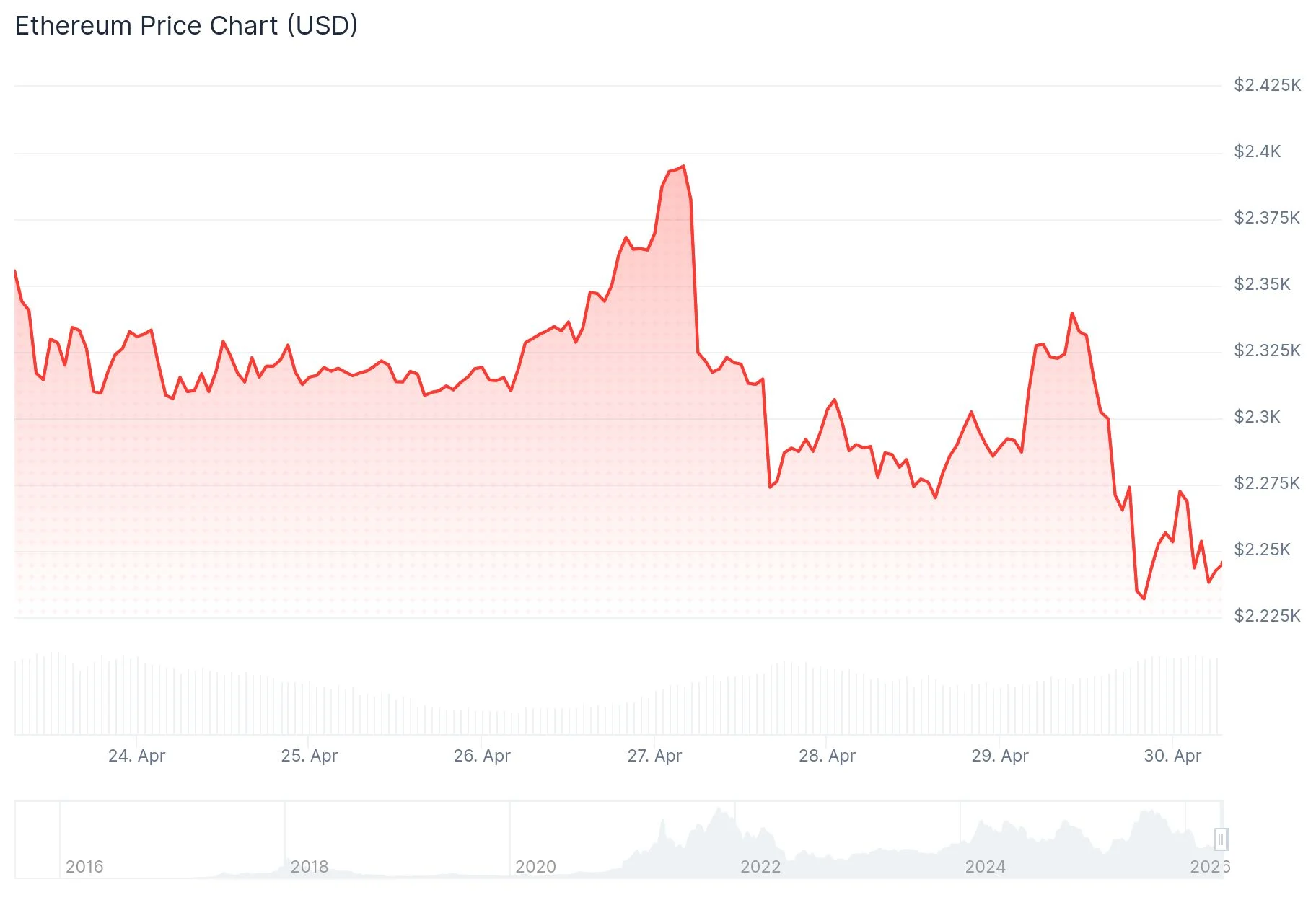
ETH reached an intraday bottom at $2,220 and is currently hovering marginally above this support zone. The digital asset has breached below an ascending channel pattern that previously maintained support around $2,295 on shorter timeframes.
Rising Exchange Balances and On-Chain Transfers Point to Distribution
Exchange balances have increased by approximately 226,000 ETH during the last three days, based on CryptoQuant analytics. Elevated exchange inflows generally indicate heightened coin availability for potential selling activity.

Blockchain monitoring service Lookonchain identified several significant wallets responsible for these transfers. Wallet addresses associated with Fenbushi Capital and Genesis Trading deposited ETH to centralized exchanges within the previous 24-hour window. Additionally, a participant from Ethereum’s original ICO transferred 10,000 ETH to a fresh wallet address after remaining inactive for approximately 11 years.
Retail market participants contributed to the downward momentum last week, collectively disposing of more than 750,000 ETH.
The Coinbase Premium Index, serving as an indicator of purchasing appetite from US-based traders, shifted into negative territory throughout this timeframe. US-based spot Ethereum ETFs recorded consecutive days of net capital withdrawals, according to SoSoValue tracking data.
Staked ETH supply contracted by 140,000 ETH throughout the preceding week. The validator exit queue expanded dramatically from under 1,000 to surpass 414,000 ETH.
On a more optimistic note, BitMine Immersion Technologies committed an additional 106,200 ETH to staking on Tuesday. The organization currently maintains 5.078 million ETH in total holdings, with 3.7 million already deployed in staking protocols.
Critical Price Thresholds Under Observation
Market analyst Daan Crypto Trades remarked on X that Ethereum has been incrementally advancing in recent weeks but hasn’t successfully broken through the $2,400 resistance zone. He suggested that surpassing this barrier would probably drive ETH into the $2,600–$2,700 territory, whereas bulls must defend the diagonal trendline support to preserve the current upward trajectory.
ETH has dropped below its 20-day, 50-day, and 100-day exponential moving averages, currently positioned at $2,287, $2,242, and $2,366 respectively. The Relative Strength Index reads 47, indicating neutral to slightly bearish conditions, while the Stochastic Oscillator has entered oversold readings.
Cryptocurrency analyst Ali Martinez highlighted on April 29 that ETH was attempting to recapture its Realized Price threshold of $2,335. This metric represents the aggregate average acquisition cost for on-chain participants. Maintaining price action above $2,335 has historically served as a precursor to sustained upward movements.
ETH experienced $149.7 million in forced liquidations over the past 24 hours, with long positions accounting for $110.3 million of that total.
Nearby support rests at $2,211, with secondary support located at $2,107. Resistance zones emerge at $2,265, followed by $2,280, and then $2,300.
