




Key Takeaways
- BTC tumbled beneath $76,000 following the Federal Reserve’s decision to maintain rates at 3.5–3.75%
- Federal Open Market Committee meeting notes highlighted Middle East geopolitical instability as a factor driving “uncertainty”
- President Trump turned down Iran’s proposal to reopen the Strait of Hormuz ahead of nuclear negotiations
- Potential U.S. military action against Iran continues to loom, creating additional downward pressure on Bitcoin
- Market analyst Ted Pillows identifies $79,000–$80,000 as the critical resistance zone BTC needs to break through
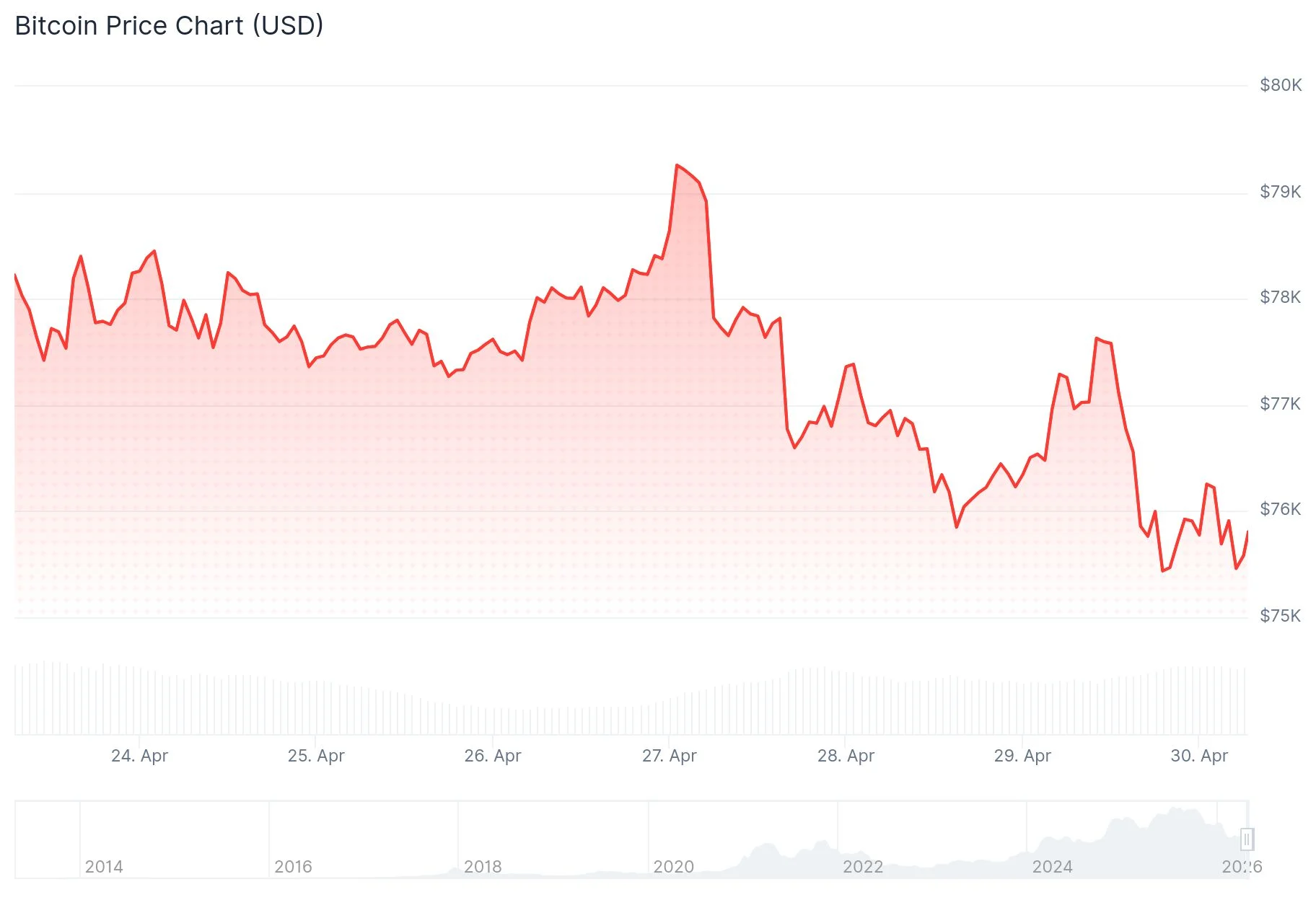
Bitcoin plunged beneath the $76,000 threshold on Wednesday amid two significant market catalysts: the Federal Reserve’s decision to maintain current interest rates, combined with President Trump’s dismissal of Iran’s recent diplomatic overture.
The central bank maintained the federal funds rate within the 3.5–3.75% range. Minutes from the FOMC meeting highlighted geopolitical “uncertainty” stemming from escalating Middle East conflicts as a primary justification for the unchanged monetary policy stance.
Following the release of the FOMC minutes, Bitcoin experienced a sharp decline to an intraday bottom of $74,937. This price point positioned BTC marginally beneath the 20-day simple moving average of $75,664, a technical indicator that market participants had been monitoring with keen interest.
Hyblock CEO Shubh Varma characterized the movement as “the usual sell the news reaction after the FOMC.” He noted that Bitcoin rebounded to pre-announcement price levels within a matter of hours, highlighting that the global bid-ask ratio surged to 0.3 — representing one of the highest measurements observed — signaling robust underlying market demand.
Market analyst Ted Pillows (@TedPillows) shared that Bitcoin had successfully retested its support zone and was showing signs of recovery. He pinpointed the $79,000–$80,000 range as the crucial resistance level that must be recaptured, cautioning that inability to breach this zone could drive BTC down toward $74,000.
Trump Dismisses Iranian Proposal, Strait of Hormuz Closure Persists
President Trump declined Iran’s diplomatic proposition to first reopen the strategically vital Strait of Hormuz before engaging in nuclear program discussions. Trump stated the maritime blockade will continue until Iran addresses American concerns regarding its nuclear ambitions, characterizing the blockade as “somewhat more effective than the bombing.”
The President also shared a message on Truth Social accompanied by the heading “NO MORE MR. NICE GUY,” urging Iran to “get smart soon.” Reports indicate that the U.S. Central Command has developed contingency plans for a limited series of strikes against Iranian targets should diplomatic negotiations continue to stall.
Crude oil prices climbed in response to these developments, exerting additional downward pressure on Bitcoin and the wider cryptocurrency market.
Insights from Glassnode Analytics
Glassnode researchers observed that Bitcoin market participants had increased bearish positions with leverage in anticipation of the FOMC announcement, evidenced by climbing open interest, stable funding rates, and discrepancies between spot and futures market indicators.
Their Week Onchain analysis characterized Bitcoin as “trapped below market mean,” with the $65,000–$70,000 range functioning as support while insufficient demand has capped upward movements. Bitcoin struggled to penetrate its True Market Mean positioned at $79,000.
Institutional capital flows into spot Bitcoin ETFs combined with expanding CME open interest have contributed to establishing a substantial accumulation zone between $65,000 and $70,000, per Glassnode’s assessment.
At the time of publication, BTC was trading near $75,700, retreating from an intraday peak above $77,000.
