



Contents
Key Takeaways
- With approximately 150 billion tokens circulating, Dogecoin maintains a market capitalization hovering around $14.2 billion, securing its position among top cryptocurrencies
- Tesla continues accepting DOGE for select merchandise, demonstrating actual commercial application beyond speculation
- Daily network activity shows roughly 22,344 transactions processed, with nominal fees averaging just $0.038 per transfer
- An unlimited supply model introduces approximately 5 billion new tokens annually, creating persistent inflationary pressure
- Wealth concentration remains high, with the top 100 addresses holding approximately 66.39% of total supply
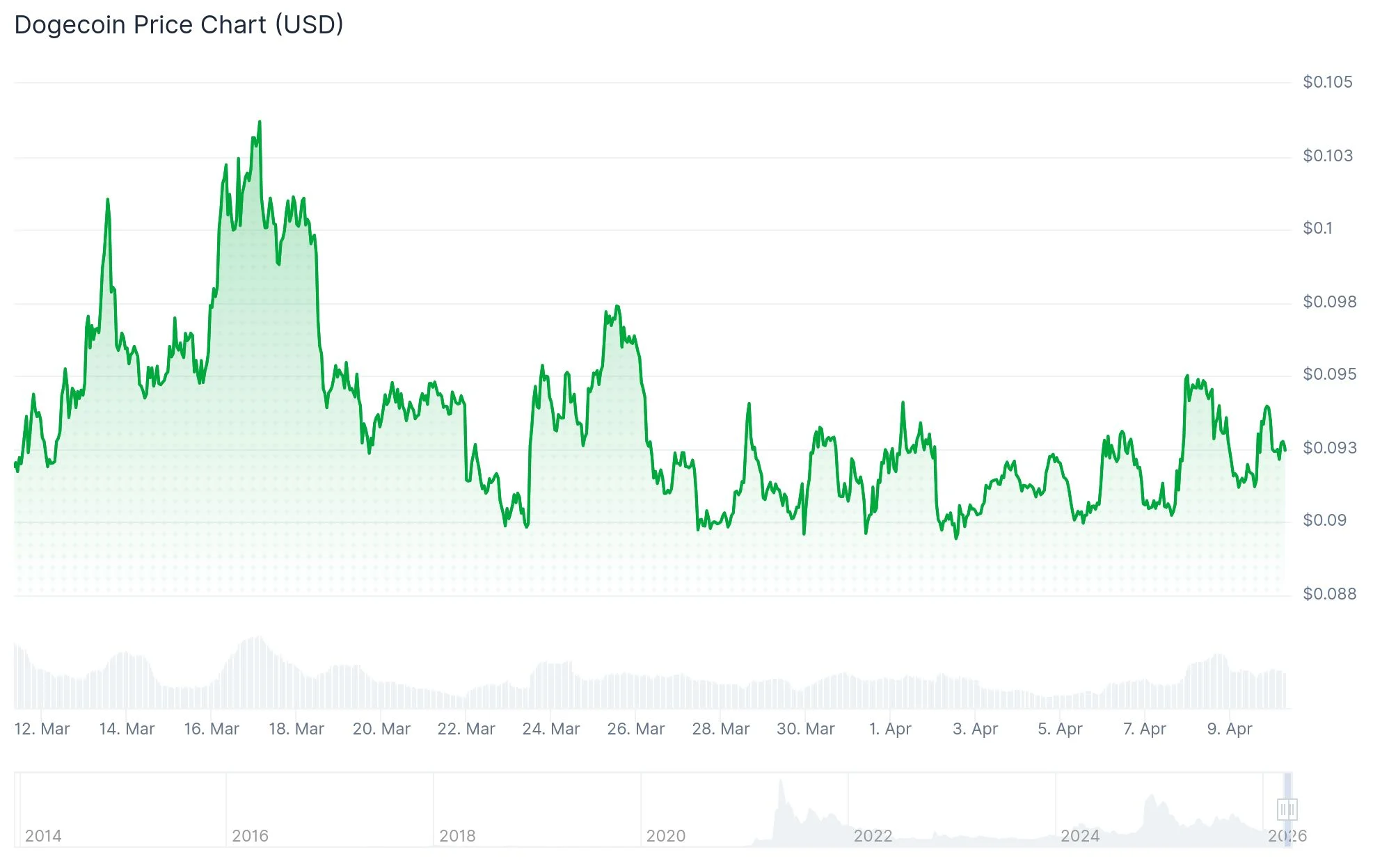
When Dogecoin launched in 2013, it was meant as satire. More than ten years on, it remains a household name in cryptocurrency circles. According to CoinGecko data, it commands a market capitalization of approximately $14.2 billion across roughly 150 billion circulating tokens.
Within cryptocurrency markets, name recognition directly correlates with trading volume. High liquidity extends project longevity beyond what fundamentals alone would suggest.
Operating on a Scrypt-based proof-of-work consensus mechanism, Dogecoin positions itself as a transactional cryptocurrency rather than a platform for smart contracts. Development efforts from the Dogecoin Foundation emphasize merchant adoption tools, including GigaWallet infrastructure designed to simplify DOGE payment integration.
Tesla’s official payment documentation continues to feature Dogecoin as an accepted option for qualifying merchandise. This represents tangible commercial adoption that separates it from purely speculative meme tokens.
Transaction Metrics and Network Usage
Data compiled by BitInfoCharts indicates the network handled approximately 22,344 transactions during the previous 24-hour window. Transaction costs remain minimal, averaging around $0.038, while the median fee hovers near $0.007. Active address counts exceeded 34,000 during this same timeframe.
These metrics confirm the network operates efficiently for basic payment transfers. For a cryptocurrency focused on transaction utility, this performance provides functional credibility.
Yet transaction volume doesn’t automatically translate into sustainable value growth. Dogecoin lacks the decentralized application ecosystem that generates fee revenue for other networks. Most participants hold for brand recognition or price speculation.
Supply Dynamics Create Headwinds
Unlike Bitcoin’s fixed maximum supply, Dogecoin implements perpetual issuance. The protocol generates 10,000 DOGE with each block, occurring approximately every sixty seconds. Annual new supply totals roughly 5 billion tokens.
While this issuance schedule compensates miners and maintains network security, it simultaneously dilutes existing holders. Sustained price appreciation requires demand growth that continuously exceeds this supply expansion.
Though the inflation rate decreases proportionally as total supply expands, this built-in dilution mechanism presents ongoing challenges for value retention.
Ownership distribution introduces additional volatility concerns. BitInfoCharts data reveals the top 100 wallet addresses control roughly 66.39% of total supply, with the top 10 commanding approximately 44.44%. Exchange wallets and major holders maintain disproportionate influence over price action.
Bottom Line Assessment
Dogecoin offers high liquidity, universal brand awareness, minimal transaction costs, and demonstrated staying power across multiple market cycles. These attributes position it favorably against most meme-based cryptocurrencies. However, its investment thesis depends primarily on sustained brand relevance and speculative interest rather than fundamental economic drivers. Allocating to DOGE essentially wagers that its cultural significance will endure indefinitely.
