



Key Highlights
- Samsung Electronics forecasts first-quarter 2026 operating profit reaching 57.2 trillion won ($37.8 billion), representing more than an 800% increase compared to the prior year.
- First-quarter revenue is anticipated to climb nearly 70% to reach 133 trillion won during the three-month period ending in March.
- Explosive growth in artificial intelligence chip requirements has created significant supply constraints in the memory semiconductor market, driving substantial price increases.
- The South Korean electronics giant has made substantial progress against competitor SK Hynix in the high-bandwidth memory (HBM) sector, delivering HBM4 products to Nvidia during February.
- Ongoing tensions in the Middle East present potential headwinds, as regional instability could interrupt the flow of essential chipmaking resources such as helium while increasing energy expenses.
Samsung Electronics has announced preliminary first-quarter 2026 operating profit of 57.2 trillion won — representing an extraordinary increase of over 800% versus the corresponding quarter last year — significantly surpassing consensus analyst projections of approximately 40–42 trillion won compiled by LSEG SmartEstimate.
Should these preliminary figures be validated, this performance would approach triple the company’s previous quarterly profit peak of 20 trillion won achieved during the fourth quarter of last year. This single quarter’s operating profit would also surpass the entire annual operating profit Samsung generated throughout 2025.
Quarterly revenue projections stand at 133 trillion won, marking a 68% expansion from the year-ago period. Complete financial details and confirmed figures will be disclosed when Samsung releases comprehensive quarterly results on April 30.
The exceptional performance stems primarily from Samsung’s memory semiconductor operations. Unprecedented demand for AI infrastructure has generated widespread shortages throughout the memory chip market, catalyzing sharp upward price movements. Industry research firm TrendForce anticipates contract DRAM pricing will advance more than 50% during the present quarter.
Meritz Securities analysts estimate Samsung’s memory chip segment alone produced approximately 54 trillion won in operating profit throughout the quarter. Meanwhile, its logic chip operations recorded losses totaling around 1.6 trillion won. The mobile device division contributed roughly 4 trillion won in operating profit, showing a modest decline on a year-over-year basis.
Closing the Technology Gap in Advanced Memory Solutions
Twelve months ago, Samsung’s chief executive delivered a rare public apology addressing the company’s financial underperformance and its technological disadvantage relative to competitor SK Hynix in providing high-bandwidth memory products to Nvidia. That competitive disparity has begun narrowing considerably.
Samsung initiated deliveries of its cutting-edge HBM4 chips to Nvidia this past February. Nevertheless, high-bandwidth memory products represented less than 10% of Samsung’s total DRAM chip revenue during the first quarter, according to analysis from Heungkuk Securities. The predominant source of the profit explosion originated from conventional DRAM demand stimulated by AI inference applications, which have intensified shortages across standard memory products.
Heungkuk Securities analysts project Samsung’s total operating profit will achieve another milestone of 75 trillion won in the second quarter, propelled by an anticipated 30%+ appreciation in DRAM pricing.
The company has additionally benefited from currency tailwinds, as the South Korean won trades near a 17-year low relative to the U.S. dollar. This exchange rate dynamic has enhanced the value of overseas earnings when converted back to the local currency.
Geopolitical Tensions Create Industry Headwinds
The escalating U.S.-Israel military conflict with Iran has introduced uncertainty for the semiconductor sector. Potential interruptions to the availability of essential materials for chip production — particularly helium — could impact manufacturing capacity at industry leaders including Samsung and SK Hynix.
Elevated energy expenses associated with the regional conflict have also prompted concerns about potential deceleration in AI data center investment during the latter half of the year.
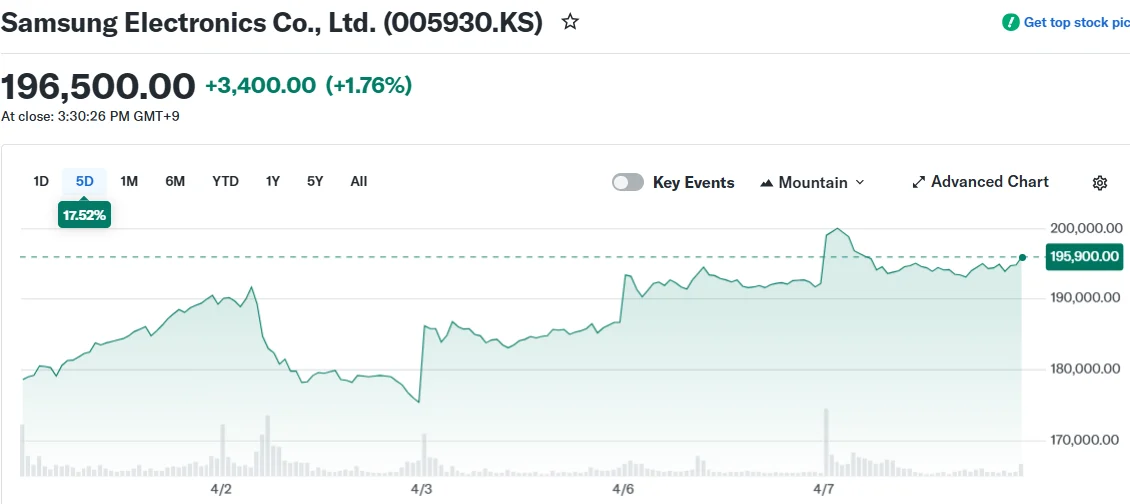
Spot market DRAM pricing softened marginally last week, with TrendForce observing that ultimate customers were experiencing difficulty absorbing the elevated price levels. Google’s introduction of a memory-efficient technology named TurboQuant in March applied additional downward pressure, contributing to a market correction that has reduced Samsung’s share price approximately 9% since military operations commenced on February 28.
Despite this recent volatility, Samsung’s equity remains elevated more than 60% year-to-date in 2026, building upon a 125% appreciation throughout 2025.
Competing chipmaker SK Hynix advanced 3.4% higher in Tuesday trading.
