




Key Takeaways
- Brent crude declined approximately 4% to near $100 per barrel following reports of a comprehensive US ceasefire proposal for Iran
- West Texas Intermediate fell 4% to $88.70, accompanied by an 8% decline in UK natural gas prices
- President Trump confirmed ongoing negotiations with Iran, though Iranian officials deny any discussions are underway
- Israeli military operations continued in Tehran despite Washington’s diplomatic overtures
- European and UK equity markets posted significant gains as energy prices retreated
As of Wednesday morning, Brent crude futures were trading at approximately $100.41 per barrel, marking a decline of nearly 4%, while West Texas Intermediate settled at $88.70.
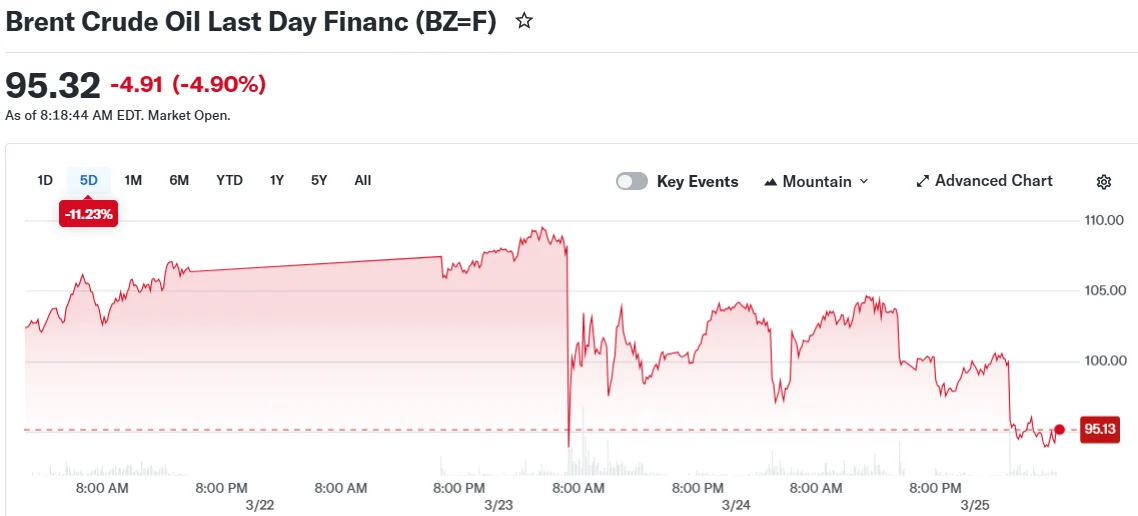
Crude oil benchmarks experienced substantial declines on Wednesday following reports that the Trump administration had transmitted a comprehensive 15-point framework to Iran designed to resolve ongoing Middle Eastern tensions. According to sources, the proposal reached Tehran through Pakistani diplomatic channels, with Islamabad extending an invitation to facilitate renewed dialogue between the two nations.
Speaking to reporters, President Trump confirmed that the United States is “in negotiations right now” with Iran, adding that Tehran appeared to be “talking sense.” He had previously characterized Monday’s discussions as “productive.”
Tehran’s response, however, contradicted Washington’s narrative entirely. Iranian representatives categorically rejected claims that negotiations were underway, asserting that American officials were merely engaging in unilateral discussions.
This diplomatic dissonance created a tense trading environment. Market participants welcomed potential de-escalation prospects while remaining cognizant that circumstances could deteriorate rapidly.
Brent crude touched an intraday low of $97.30 before mounting a modest recovery. West Texas Intermediate similarly plunged 4% to $88.70 per barrel. Concurrently, UK natural gas futures declined 8%.
Equity Markets Surge as Energy Costs Ease
The retreat in energy commodities provided a boost to global stock indices. London’s FTSE 100 advanced more than 1%, adding 103 points to reach 10,068. Germany’s DAX index jumped 1.6% while France’s CAC 40 climbed 1.5%. Asian trading sessions had already recorded robust gains prior to European market opens.
Matt Britzman, senior equity analyst at Hargreaves Lansdown, commented: “Oil prices have retreated on these developments, providing some respite to equity markets that had been pressured by inflation concerns and the resulting implications for monetary policy.”
Richard Hunter, head of markets at interactive investor, adopted a more measured perspective, noting that the FTSE 100 remains approximately 8% below its late February record high.
Hormuz Strait Blockage Remains Critical Issue
The primary bottleneck continues to be the Strait of Hormuz, the vital maritime corridor that has been essentially closed due to Iranian threats against commercial oil tankers. This disruption has been the principal driver behind recent price surges.
ING analysts noted: “Notwithstanding the initial market optimism, substantial uncertainty persists. Volatility continues at elevated levels and a geopolitical risk premium remains embedded in prices.”
Paradoxically, even as diplomatic communications were reportedly in progress, Israeli forces conducted strikes on Tehran Wednesday — introducing additional complexity to an already convoluted situation.
The Pentagon is also making preparations to deploy an additional 1,000 military personnel to the region, supplementing the 50,000 troops already stationed there.
Britzman offered a frank assessment of what market normalization would require: “Public statements and diplomatic posturing can only achieve limited results, and any meaningful and sustained price reduction will likely require the complete reopening of the Strait of Hormuz.”
Crude prices continue to trade substantially above pre-conflict levels, and the Strait of Hormuz remains closed to normal commercial traffic.
