



Key Points
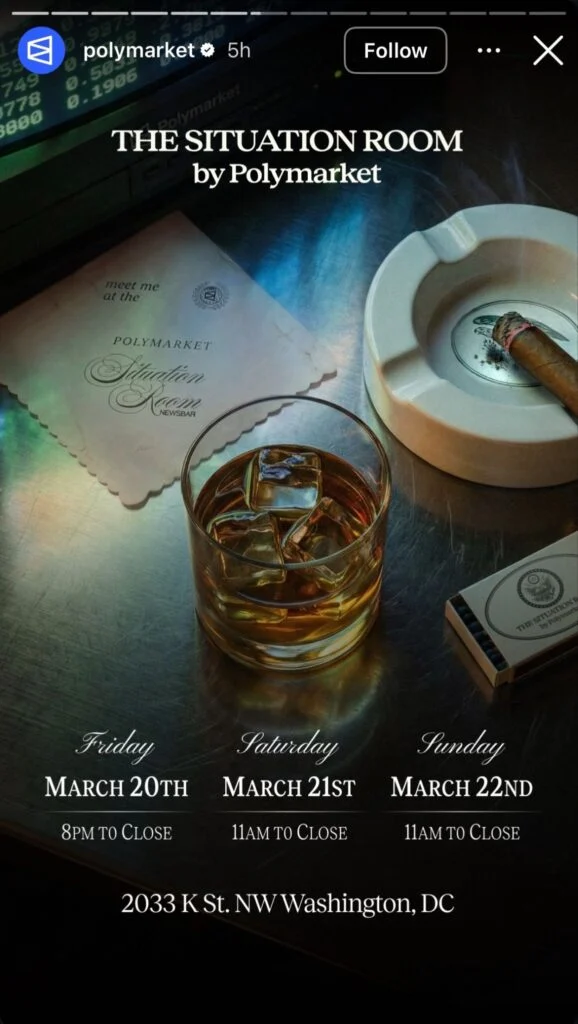
- A three-day pop-up bar named “The Situation Room” was launched by Polymarket in Washington DC during March 20-22
- Global Situation Room, a PR company, issued a cease and desist notice citing trademark violation
- Gambling is Not Investing, an advocacy group, staged a protest with a mobile billboard outside the venue
- After initially seeking dialogue with GSR’s legal team, Polymarket ceased communication
- Technical difficulties plagued the venue’s opening, with non-functioning televisions driving away guests
A weekend pop-up bar initiative by Polymarket in the nation’s capital quickly became entangled in legal complications. The prediction platform’s choice to name its temporary establishment “The Situation Room” prompted immediate trademark objections from an established Washington DC public relations agency.
Global Situation Room, a communications firm with trademark protection spanning approximately ten years, dispatched legal notification to Polymarket on March 19. This action came merely 24 hours after Polymarket’s social media announcement of the pop-up venue.
Shane Delsman of Godfrey & Kahn, serving as GSR’s consulting attorney, drafted the legal correspondence. The document alleged that Polymarket’s use of “The Situation Room” constituted trademark infringement against GSR’s protected intellectual property.
Additionally, GSR argued that the overlapping branding generated misleading associations between the PR agency and Polymarket. The firm reported fielding media inquiries regarding the pop-up event, which it presented as concrete evidence of marketplace confusion.
The legal demand ordered immediate discontinuation of the name usage. Furthermore, it mandated removal of all “The Situation Room” references from promotional content.
Polymarket faced a same-day deadline of March 19 for compliance. GSR indicated its readiness to pursue additional legal remedies absent an acceptable response.
Communication Breakdown Following Initial Contact
Brett Bruen, CEO of GSR, reported that Polymarket initially expressed interest in convening with the company’s legal representatives. Subsequently, the prediction market platform discontinued all communication, Bruen stated.
Bruen characterized the circumstances as “a bit bizarre.” He theorized that Polymarket “didn’t do their homework and just burst into the beltway for a publicity stunt.”
He clarified that GSR maintains an operational situation room for crisis surveillance and event hosting. He noted that Polymarket’s promotional language bore striking resemblance to GSR’s own service descriptions.
Bruen emphasized the complexity of securing the trademark. GSR navigated challenges from the patent and trademark office, which initially contended “situation room” qualified as military terminology.
He acknowledged that CNN operates “The Situation Room” as a television program, though he distinguished that a news broadcast and a PR agency operate in sufficiently distinct markets to prevent confusion. CNN declined to provide commentary regarding the trademark controversy.
Venue Proceeds Despite Legal Challenges and Public Opposition
The temporary establishment occupied Proper 21, a K Street sports bar in Washington. Co-owner Rob Zahn verified the brief takeover arrangement spanning March 20 through 22.
While Polymarket attempted to maintain location confidentiality, online investigators revealed the address before launch. Operating hours ran from 8 p.m. until closing on Friday, extending to 11 a.m. through closing on Saturday and Sunday.
The space showcased live X platform feeds, flight tracking displays, Bloomberg financial terminals, and Polymarket interface screens. On X, Polymarket promoted it as the “world’s first bar dedicated to monitoring the situation.”
Friday evening brought Gambling is Not Investing, an anti-prediction market organization, which deployed a mobile billboard vehicle. The organization, headed by former congressman and Trump administration chief of staff Mick Mulvaney, displayed messaging highlighting that prediction markets lack equivalent protections to regulated sportsbooks.
The inaugural evening encountered operational problems. Several sources confirmed that television systems failed to function on Friday. With March Madness entering its second day, disappointed attendees departed prematurely.
The brief duration of the pop-up seemingly provided Polymarket strategic protection regarding the legal dispute. Before any enforcement mechanisms could materialize, the event concluded.
Polymarket declined all requests for official statements. Bruen informed Gambling Insider that “the real damage will be left behind.”
