



TLDR
- Shares of PayPay began trading at $19, marking a 19% premium over the $16 IPO pricing
- The Japanese fintech raised around $880 million by issuing 55 million American Depositary Shares
- First-day trading valued the company at roughly $12.7 billion to $14.7 billion
- The digital payments platform serves approximately 72 million users and handles more than $100 billion in transaction volume
- A strategic Visa partnership was unveiled to facilitate potential U.S. expansion efforts
SoftBank-backed digital payments provider PayPay (PAYP) launched on the Nasdaq exchange March 12, 2026, with shares beginning at $19 — a solid 19% premium over the company’s $16 initial public offering price. The Japanese fintech had set its IPO pricing beneath the anticipated $17–$20 range.
The public offering generated roughly $880 million in capital through approximately 55 million American Depositary Shares. Both PayPay and an investment vehicle controlled by SoftBank participated as selling shareholders.
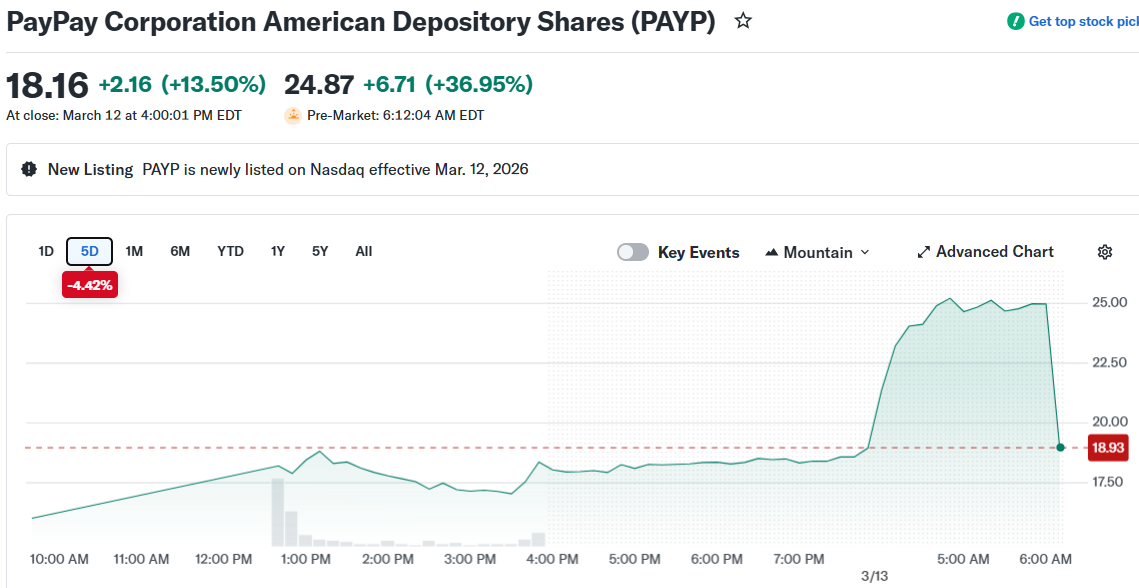
Based on trading activity, the fintech’s initial market capitalization landed between approximately $12.7 billion and $14.7 billion. By Thursday afternoon, shares had moderated to roughly $18.03, showing typical first-day price fluctuation following the enthusiastic debut.
This marks SoftBank’s first majority-owned portfolio company to list on U.S. exchanges since semiconductor designer Arm’s 2023 public offering.
Originally scheduled for December, the listing faced postponement when a U.S. government shutdown disrupted the Securities and Exchange Commission’s approval timeline.
Strong Domestic Market
PayPay launched in 2018 through a joint venture between SoftBank and Yahoo Japan. The platform gained rapid traction by eliminating transaction fees for small and medium-sized businesses for as long as three years, aggressively building merchant acceptance.
This growth-focused approach delivered results. The company now serves roughly 72 million registered users across Japan and has facilitated over $100 billion in total transaction volume.
“The appeal of the company is that it’s one of the few fintech IPOs that have already won its domestic market,” said IPOX Research Associate Lukas Muehlbauer.
Despite PayPay’s dominance, Japan continues to trail other developed nations in digital payment adoption, suggesting significant domestic expansion opportunities remain.
CEO Ichiro Nakayama ceremonially opened trading at Nasdaq’s Market Site in New York Thursday morning. Speaking with Reuters, he outlined ambitions to evolve beyond payments into a comprehensive financial services ecosystem following the public listing.
The platform has diversified into credit products, banking services, investment securities, and insurance offerings.
Eyes on the U.S.
February 2026 brought news of a Visa collaboration designed to evaluate potential entry into the American market. Specific launch timelines and strategic details have not been disclosed.
Visa stock declined approximately 0.55% to $307.25 Thursday, while PayPal shares dropped roughly 1.60% to $44.84.
Wall Street analysts participating in the IPO underwriting are anticipated to publish coverage and price targets around early April, following the customary quiet period restrictions.
PayPay’s public debut served as an important barometer for the new issue market, which has experienced turbulence recently. Geopolitical volatility stemming from Middle East developments had already prompted several companies to postpone their listing calendars.
“Given the backdrop, it’s a positive for the IPO market that PayPay is trading well so far,” said Nicholas Einhorn, Vice President of Research at Renaissance Capital.
