




TLDR
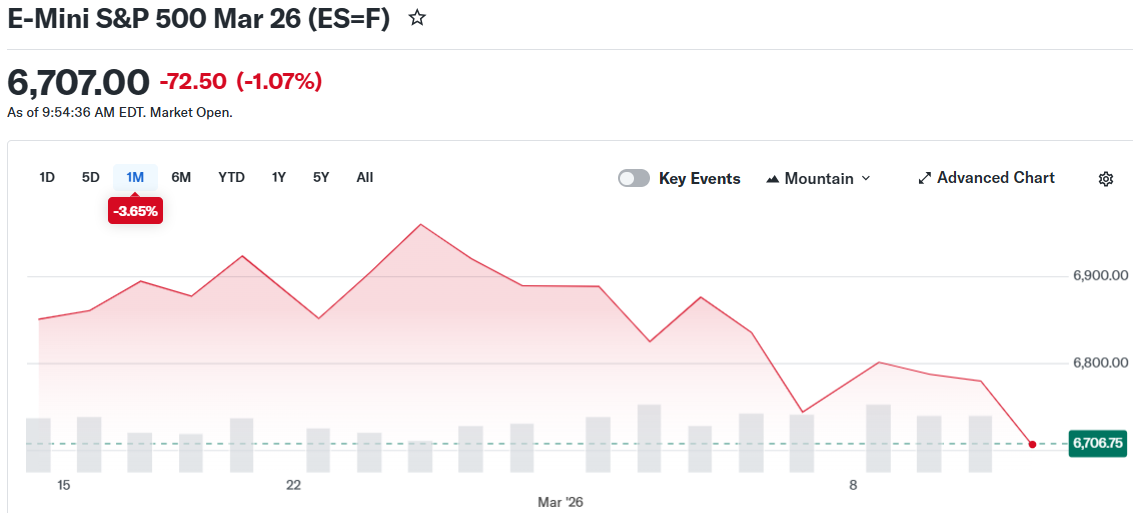
- Since military operations against Iran commenced, the S&P 500 has declined approximately 1.4%, trading roughly 3% beneath its January peak.
- Despite the International Energy Agency’s unprecedented 400 million barrel emergency stockpile release, crude prices continue climbing.
- Futures trading indicates oil won’t stabilize to pre-conflict pricing until August 2027.
- Goldman Sachs adjusted its economic projections, anticipating accelerated inflation, reduced growth, and elevated unemployment linked to the military engagement.
- The 10-year Treasury yield surged 24 basis points, reaching 4.23%—the highest level in more than 30 days.
Financial markets are experiencing sustained pressure as the U.S. military campaign against Iran approaches its second week, with crude prices advancing, bond yields climbing, and economic forecasters revising their projections downward.
The S&P 500 has shed approximately 1.4% since American airstrikes commenced against Iran in late February. While the benchmark index remains just 3% off its January all-time high, market strategists caution that prolonged military engagement could trigger additional downside.
Crude oil prices experienced sharp acceleration this week following attacks by Iran-aligned forces on commercial tankers navigating the Strait of Hormuz. This critical waterway facilitates approximately 20% of global daily petroleum flows. Wednesday witnessed strikes on three separate vessels in the strategic passage.
In an unprecedented response, the International Energy Agency authorized the deployment of 400 million barrels from strategic petroleum reserves to address supply disruptions. Nevertheless, commodity traders anticipate oil won’t revert to pre-conflict valuations until August 2027, based on current futures market pricing.
President Trump announced plans to invoke Defense Production Act authority to resume offshore drilling operations along California’s coastline. While Trump previously suggested the military operation would conclude “very soon,” Goldman Sachs and competing institutions are now modeling scenarios involving extended disruption.
Inflation and Growth Outlook Worsens
Goldman Sachs modified three critical economic indicators this week, each directly connected to the Iran military situation. The investment bank now forecasts accelerated inflation pressures, dampened economic expansion, and rising joblessness.
Ten-year Treasury yields advanced to approximately 4.23%, representing a 24-basis-point increase from late February levels. Thirty-year government bond yields reached 4.9% during early Thursday sessions. Market observers attribute this movement to apprehension regarding fiscal discipline deterioration and ambiguity surrounding inflation trajectories and monetary policy direction.
The Federal Reserve confronts a particularly challenging environment. Elevated petroleum costs fuel inflationary pressures, potentially compelling the central bank to maintain restrictive rates for extended periods, effectively eliminating prospects for rate reductions in the current year.
ING strategist Francesco Pesole suggested that emergency reserve releases might actually transmit pessimistic signals to market participants. He indicated these actions suggest international policymakers perceive minimal probability of swift conflict resolution.
Iran’s Military and Nuclear Risks
Iran retains operational short-range missile systems, unmanned aerial vehicles, and maritime mining capabilities that can be deployed to interrupt commercial shipping. Strategic analysts indicate that completely securing Strait of Hormuz navigation lanes could necessitate ground force deployment—representing significant military escalation.
Iran maintains substantial quantities of 60% enriched uranium, approaching weapons-grade concentration. Specialists at the Nuclear Threat Initiative caution that should the Iranian government endure the military campaign, it may possess both capabilities and incentives to develop nuclear armaments.
Persian Gulf nations, significantly vulnerable to Iranian military actions and reliant upon American defensive systems, are expressing mounting dissatisfaction with Washington through diplomatic channels. Multiple analysts suggest the region confronts two unfavorable scenarios: an Iran that persists and reconstructs its capabilities, or a destabilizing leadership void.
Wall Street institutions have not yet modified year-end S&P 500 projections, which continue forecasting a 14% appreciation from present valuations. However, strategists note the index has remained confined within a 4% trading band for 14 consecutive weeks.
Remember: Preserve all tokens like [[EMBED_0]], [[IMG_0]], [[LINK_START_0]], [[LINK_END_0]], [[SCRIPT_0]], [[FIGURE_0]] etc. exactly as they appear. These are placeholders for embeds, images, and links that must not be changed.
