




Contents
Key Highlights
- Supreme Court blocked emergency tariff powers, prompting Trump to implement 15% global tariffs under alternative legal authority
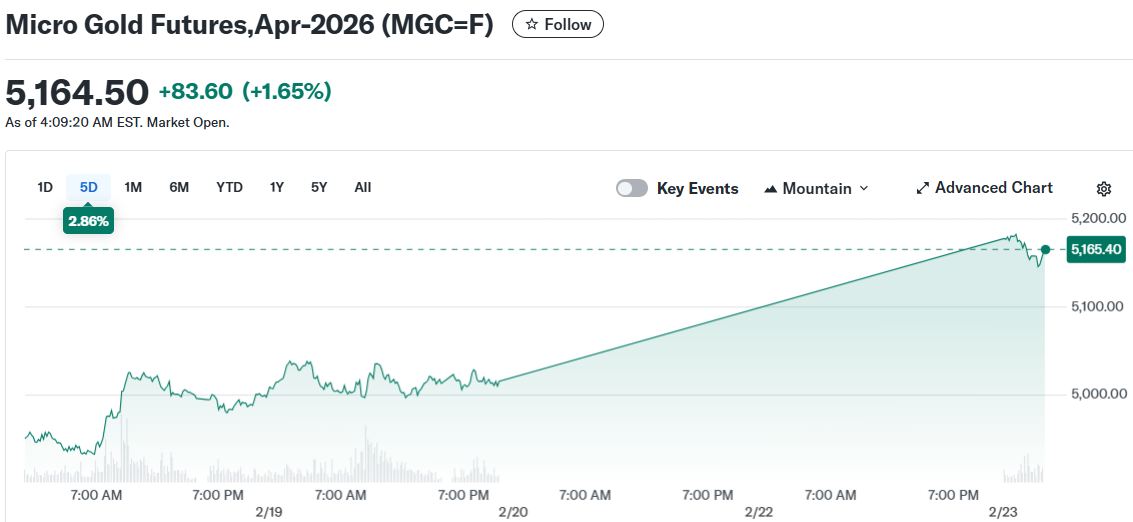
- Gold extended its winning streak to four consecutive sessions, reaching $5,170 on U.S. futures markets
- Major trade agreements with EU, India, and Japan face uncertainty and potential delays
- Weakening economic growth combined with persistent inflation drives safe-haven investment flows
- Silver gains 2.3% to reach $86.56/oz; hedge fund positioning at lowest level in nearly 12 months
Precious metals markets saw significant upward momentum on Monday as gold extended its rally following President Trump’s announcement of a sweeping 15% tariff on global imports, triggering market volatility and heightened safe-haven demand.
U.S. Gold Futures advanced 1.8% to reach $5,170.19 per ounce. Spot gold traded 0.8% higher at $5,148.66 an ounce during Monday’s morning session.
This development came after the Supreme Court blocked the administration’s attempt to invoke emergency powers for imposing import duties. In response, Trump utilized Section 122 of U.S. trade legislation, initially proposing a 10% tariff before escalating it to the 15% ceiling permitted under that provision.
International Trade Agreements Face Uncertainty
The Supreme Court’s decision has created significant doubt around multiple bilateral trade arrangements. The European Union’s top trade official indicated plans to recommend postponing the ratification of their agreement with the United States pending greater clarity on American trade strategy.
Delegates from India canceled their scheduled visit to the United States. A senior member of Japan’s governing party characterized the current situation as “a real mess.”
This ambiguity prompted investors to retreat from risk-oriented positions. Capital flowed toward gold and U.S. Treasury securities as market participants awaited further details regarding tariff implementation, timeframes, and possible legal contestation.
Dollar weakness provided additional support for gold’s upward trajectory. The Bloomberg Dollar Spot Index declined 0.2% on Monday, matching Friday’s decrease. A softer dollar enhances gold’s affordability for international buyers using alternative currencies.
Economic Slowdown and Inflation Concerns Boost Gold Appeal
Recent U.S. economic indicators released last week reinforced the investment case for gold. Fourth-quarter GDP expansion registered only 1.4% on an annualized basis, representing a substantial deceleration from the previous quarter.
Concurrently, the Federal Reserve’s favored inflation gauge — the PCE index — indicated consumer prices increased 2.9% year-over-year in December. The core measurement approached 3.0%, remaining significantly above the Fed’s 2% objective.
The convergence of decelerating economic expansion with stubbornly high inflation represents a scenario that traditionally benefits gold as both a wealth preservation tool and economic insurance.
Escalating geopolitical tensions between the United States and Iran maintained upward pressure on precious metals. While diplomatic discussions regarding Iran’s nuclear capabilities continue, substantial U.S. military deployments in the region sustain cautious market sentiment.
Performance Across the Precious Metals Complex
Silver posted gains of 2.3% to settle at $86.56 per ounce. Platinum advanced 0.3% to $2,164.60/oz. Copper futures showed minimal movement.
Commodity Futures Trading Commission data reveals hedge fund net-long positions in gold futures have declined to their lowest point in approximately one year, indicating potential capacity for additional buying momentum.
Spot gold was quoted at $5,134.16 during Monday afternoon trading in Singapore, with market analysts cautioning that near-term price fluctuations remain probable as U.S. trade policy continues evolving.
