




Key Takeaways
- May 14 marks the U.S. Senate Banking Committee’s examination of the CLARITY Act, a bill that could establish regulatory boundaries for digital assets
- The debate over stablecoin yield mechanisms has emerged as a central battleground, with traditional finance institutions favoring restrictions while digital asset companies seek operational freedom
- Bitcoin maintains support above the $80,000 level while encountering overhead pressure in the $81,000–$83,000 range
- Spot Bitcoin ETF inflows show signs of stabilization but remain insufficient to offset substantial redemptions recorded from late 2025 through early 2026
- Coinbase delivered consecutive quarterly deficits, with revenues contracting from $2.03 billion to $1.43 billion compared to the previous year
Multiple catalysts are converging this week that may influence cryptocurrency market trajectories. Legislative developments, Bitcoin’s technical positioning, institutional fund flows, and major exchange performance metrics are simultaneously commanding market attention.
The Senate Banking Committee has scheduled a markup session for the CLARITY Act on May 14. This proposed legislation seeks to establish definitive parameters for categorizing digital assets under either securities or commodities frameworks. The measure would delineate distinct jurisdictional boundaries between the Securities and Exchange Commission and the Commodity Futures Trading Commission regarding market oversight responsibilities.
Among the bill’s most contentious provisions are regulations governing stablecoin incentive programs. According to Reuters reporting, the legislation would permit rewards connected to transaction activity while prohibiting yield generation on dormant stablecoin balances. Digital asset platforms advocate for operational latitude in designing payment-based incentive structures. Traditional banking institutions prefer constraints on any mechanisms resembling deposit interest.
The implications extend broadly because stablecoins function as fundamental infrastructure across exchange operations, payment networks, and decentralized financial protocols. Regulatory certainty could enable product development with reduced compliance uncertainty. Conversely, restrictive outcomes might compel platforms and token issuers to restructure their user incentive models.
Bitcoin (BTC) Maintains $80K Support While Testing Upper Boundaries
Bitcoin advanced beyond the $80,000 threshold during the previous week, supported in part by momentum in Asian equity markets. Market technicians have indicated that sustained bullish continuation may depend on clearing the $81,000 to $83,000 zone, per Barron’s analysis.
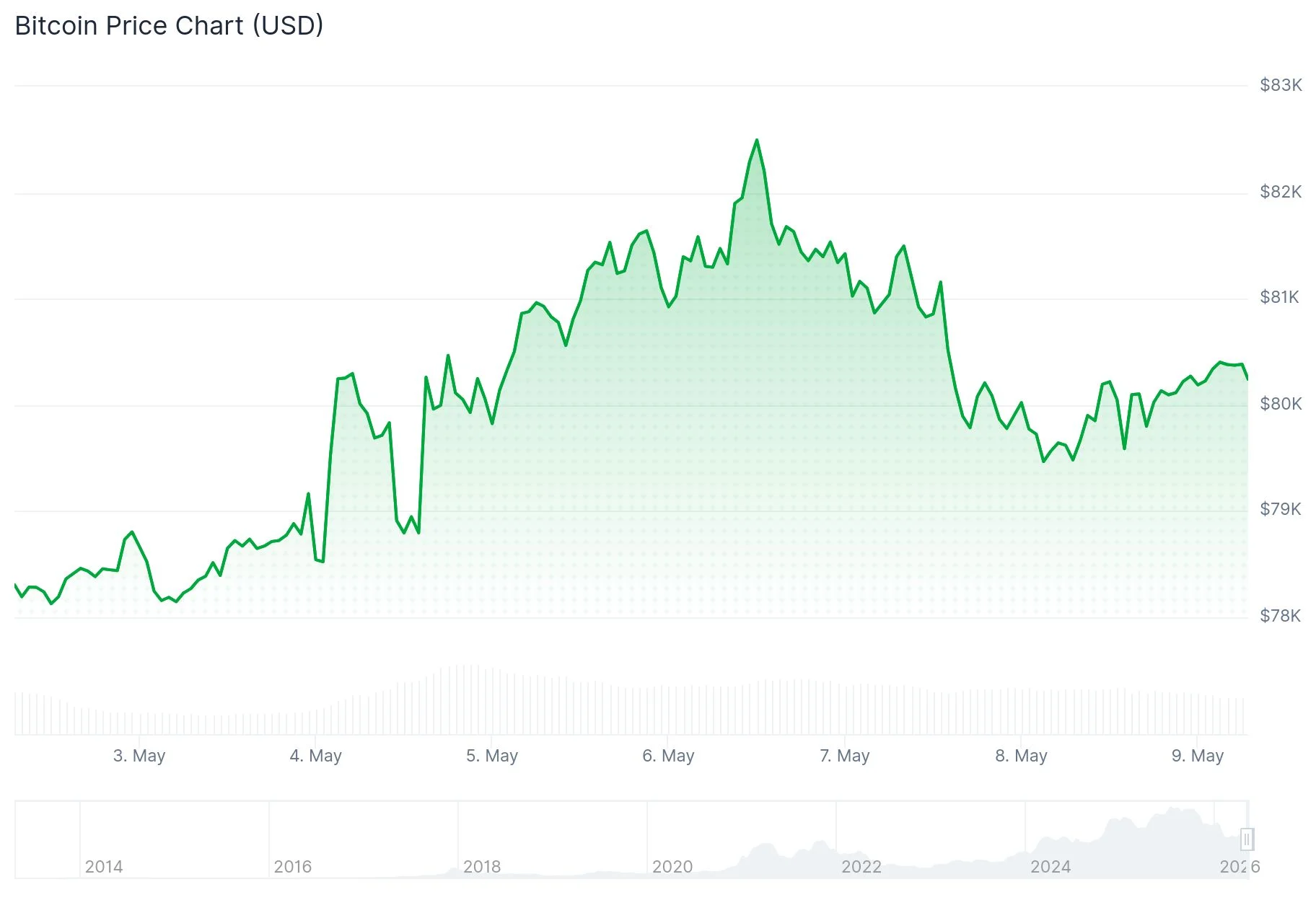
Should Bitcoin preserve current support levels while exchange-traded product demand remains consistent, retail participation could accelerate. Alternatively, stalling action near resistance zones might trigger increased caution among market participants following the recent price appreciation.
Exchange-traded fund activity represents a critical component of this market dynamic. Demand for Bitcoin investment vehicles has demonstrated improvement across recent trading sessions. However, CoinDesk analysis indicates the recovery remains incomplete relative to the significant redemption wave experienced from November 2025 through February 2026.
Daily flow metrics throughout the coming sessions will provide insight into whether institutional allocators continue building positions. Robust inflows would reinforce the recovery narrative. Neutral or negative flow patterns would challenge assumptions about the durability of institutional support.
Coinbase (COIN) Reports Consecutive Quarterly Deficit
Coinbase disclosed additional quarterly losses amid declining platform activity. Revenue contracted to $1.43 billion from $2.03 billion year-over-year. Transaction-derived revenue decreased 40% to $756 million, according to Reuters data.
As the most prominent publicly-traded cryptocurrency exchange, Coinbase serves as a barometer for retail trading engagement. Diminished transaction volumes on the platform typically mirror broader reductions in retail market participation.
Alternative cryptocurrencies also warrant attention during this period. Following Bitcoin consolidation phases, capital frequently rotates toward assets including Solana, Ethereum, and XRP as traders pursue amplified returns. This week, narratives surrounding stablecoin regulation, legislative clarity, and asset tokenization are positioned to influence interest in sector-specific tokens.
Alternative assets demonstrate heightened sensitivity to sentiment fluctuations. Should Bitcoin encounter difficulty penetrating resistance levels or ETF flows deteriorate, smaller-capitalization tokens could experience accelerated downside relative to benchmark assets.
The May 14 CLARITY Act markup session represents the week’s most significant scheduled event. Its outcomes carry implications for trading platforms, stablecoin issuers, and asset valuations throughout the digital currency ecosystem.
